



Tablet Tooling Storage Best Practices for Damage Prevention
Tablet punches and dies should not move directly from cleaning into an unmarked drawer or shared container. A controlled storage process should include complete cleaning and drying, condition inspection, suitable corrosion protection, individual separation, clear identification, environmental monitoring, and a release check before reuse.
This guide focuses specifically on storing upper punches, lower punches, and dies. Readers who need broader context on tooling categories can refer to tablet press tooling types.
Effective tablet tooling storage must control four risks:
- Physical contact and handling damage
- Corrosion, moisture, and condensation
- Product, cleaner, or lubricant contamination
- Tool-set identification and status errors
A cabinet can organize tooling, but it cannot correct incomplete drying, unidentified damage, an incompatible protectant, or poor handling.
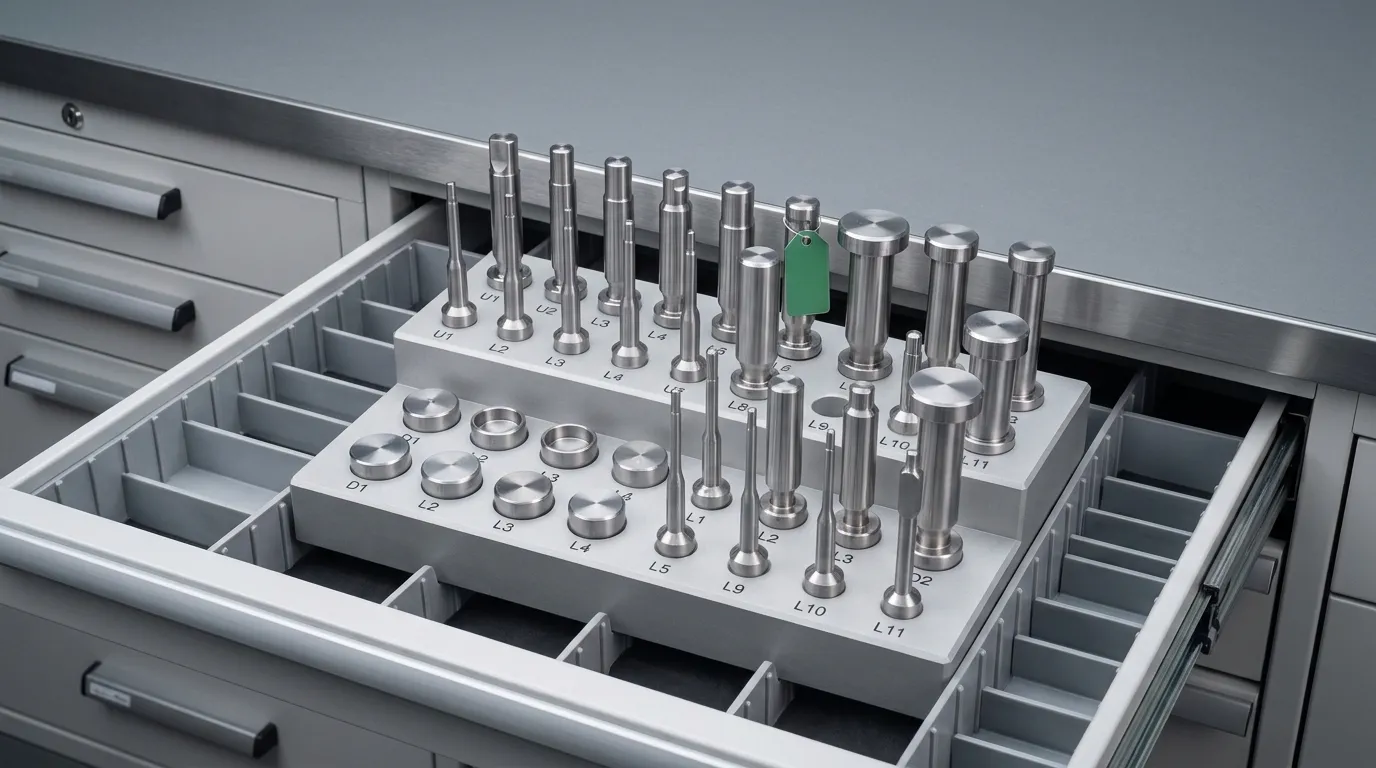
Start With a Controlled Pre-Storage Process
Storage begins when the tooling leaves the tablet press, not when the storage container is closed.
Use a defined sequence:
- Move the tooling in a protected tray or case.
- Clean it using the facility’s approved procedure.
- Dry every surface completely.
- Inspect the full punch-and-die set.
- Record its condition and completeness.
- Assign a released, restricted, or quarantined status.
- Apply an approved storage protectant when required.
- Place each component in its designated storage position.
The procedure should identify who performs each step, which materials are approved, what records are required, and who can release the tooling for future use. For pharmaceutical operations subject to U.S. requirements, 21 CFR 211.67 requires written procedures for equipment cleaning and maintenance, including responsibilities, schedules, methods, materials, inspection, and protection before use.
Clean and Dry Every Tooling Surface
Remove tablet residue, cleaning-agent residue, old lubricant, and visible contamination before storage. Pay particular attention to:
- Punch cups and tips
- Embossed or engraved features
- Punch keys and recessed areas
- Die bores and edges
- Areas where water can remain after washing
A tool that appears dry externally may still retain moisture in a cup, bore, keyway, or recessed identification mark. Protective oil or grease should never be applied over retained water because the coating may trap moisture against the metal surface.
The World Health Organization’s cleaning validation guidance states that cleaned equipment should be stored dry and that storage periods and conditions before reuse should be addressed in the validated process.
The actual cleaner, drying method, and acceptance criteria should come from the facility’s approved procedure and the tooling material or coating supplier. One process should not be assumed suitable for every tool steel or surface treatment.
Inspect the Set and Assign Its Status
Inspection should occur before a heavy protectant is applied because oil or grease may make small surface defects harder to see.
Check for:
- Corrosion or discoloration
- Chips, dents, scratches, or impact marks
- Damaged punch tips, cups, or embossing
- Coating damage or peeling
- Burrs around die edges
- Unusual marks inside the die bore
- Missing or unreadable identification
- Missing punches or dies
- Evidence of incorrect handling
Reconcile the number of upper punches, lower punches, and dies against the set record. An incomplete or unidentified set should not enter normal released storage.
Tooling with visible damage, uncertain identity, incomplete cleaning records, or unknown protectant status should be segregated for further assessment.
Prevent Contact and Handling Damage
Metal-to-metal contact is one of the most preventable storage risks. Punches can be damaged when they strike one another inside loose bins, shift in an oversized tray, or rest directly on precision surfaces.
The storage system should prevent:
- Punch-to-punch contact
- Punch-to-die contact
- Die-to-die impact
- Weight resting on punch tips or cups
- Movement when a drawer or tray is opened
- Loose components rolling during transport
Precision features requiring particular protection include punch tips, cups, embossing, heads, barrels, keys, die edges, and die bores.
Separate and Support Vulnerable Tooling Surfaces
Each component should have a stable position that supports it without placing unnecessary pressure on a critical working surface.
Suitable supports may include:
- Fitted tooling inserts
- Numbered tray positions
- Clean individual sleeves
- Non-shedding dividers
- Purpose-designed drawer organizers
Insert materials should be cleanable, stable, nonabrasive, and compatible with approved cleaners and storage protectants. Dirty, absorbent, damaged, or shedding foam can introduce particles, retain moisture, or abrade polished surfaces.
Loose storage in a shared metal or plastic bin should be avoided, even when the tools have been coated with oil. Lubrication does not prevent impact damage.
There is no universally correct rule that every punch must be stored vertically or horizontally. Orientation should be selected according to:
- Punch geometry
- Organizer design
- Stability
- Protection of the tip and cup
- Tool supplier instructions
- Safe access during removal
The correct orientation is the one that securely supports the component and prevents movement or loading on vulnerable areas.
Protect Tooling During Internal Transport
Damage may occur before the tooling reaches the cabinet. Use a dedicated tray or transport case when moving components between:
- The tablet press
- Cleaning area
- Inspection station
- Maintenance room
- Tooling-storage area
Every component should be secured before movement. Carrying several loose punches by hand or placing them together on an unprotected trolley creates unnecessary impact and drop risk.
A transport case should not automatically be treated as a long-term storage system. Its enclosure, insert material, cleanliness, moisture control, and labeling must still be evaluated.
Control Corrosion, Moisture, and Condensation
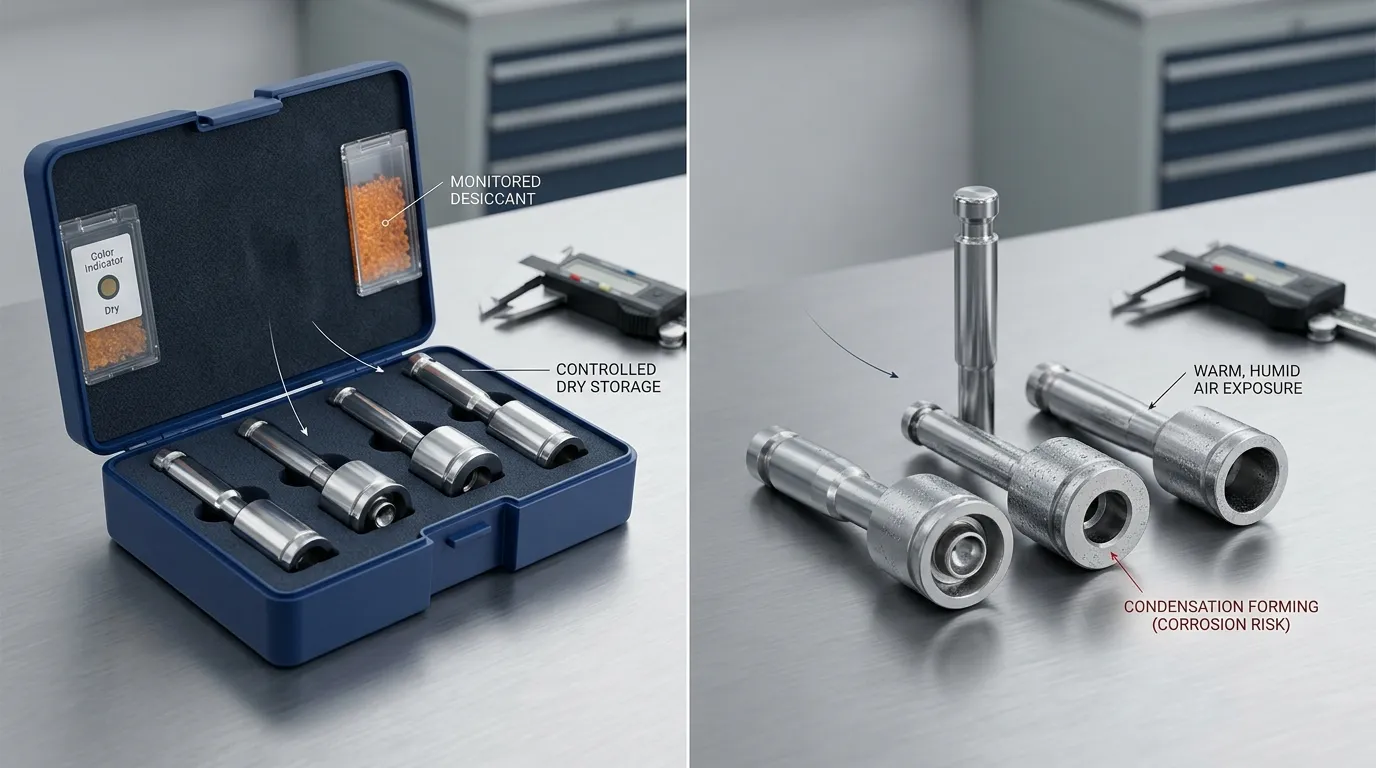
Corrosion risk is influenced by more than room humidity. Relevant factors include:
- Tool steel and heat treatment
- Surface finish
- Coating condition
- Residual product or cleaning chemicals
- Salts from handling
- Retained water
- Airborne pollutants
- Temperature changes
- Storage duration
- Protectant compatibility
Complete drying remains the first corrosion-control step. A cabinet or desiccant cannot reliably compensate for tools stored while still damp.
The storage area should be clean, dry, and protected from repeated environmental changes. Avoid locations close to wash stations, uncontrolled exterior walls, chemical vapors, leaking utilities, or frequently opened exterior doors.
Room or enclosure limits should be defined through a facility risk assessment using actual tooling materials, coatings, local climate, storage duration, and monitoring capability. One temperature or relative-humidity value should not be presented as universally correct for every facility.
Prevent Condensation During Room and Container Transitions
Condensation can form when cooler metal is exposed to warmer, humid air. This means tooling can become wet even when it was dry inside its previous room or container.
Risk increases when:
- A cold storage box is opened immediately in a warmer room
- Tooling moves between areas with large temperature differences
- An air-conditioned room receives humid outside air
- Containers are repeatedly opened during environmental fluctuations
Where a significant temperature difference exists, follow an approved equilibration procedure before opening the enclosure. If visible moisture appears, stop the process, dry and reinspect the tooling, and determine whether the event requires quarantine.
General metal-preservation guidance from the U.S. National Park Service identifies moisture, contaminants, temperature changes, and unsuitable storage materials as factors that can accelerate metal deterioration. Those principles are useful for understanding corrosion mechanisms, although pharmaceutical facilities must establish their own qualified limits and procedures.
Use Protectants, Desiccants, and VCI Materials Carefully
A storage protectant may reduce corrosion risk, but it must be selected for the specific tooling and storage conditions.
Confirm:
- Tool steel and coating compatibility
- Application thickness
- Intended storage duration
- Product-contact implications
- Removal procedure
- Cleaner compatibility
- Residue risk
- Inspection requirements
An operating lubricant intended for short production intervals may not provide suitable long-term corrosion protection. Conversely, a heavy long-term protectant may require more extensive removal and re-cleaning before the tool returns to production.
Desiccants can help inside an appropriately sealed enclosure, but they are not maintenance-free. Their performance depends on:
- Enclosure leakage
- Desiccant capacity
- Existing moisture load
- Storage duration
- Replacement or regeneration schedule
- Condition indicators, where used
Volatile corrosion inhibitor materials may be considered for some enclosed applications, but their compatibility, safety documentation, replacement interval, coating effects, and product-contact implications must be reviewed first.
| Control | Appropriate use | Main limitation |
|---|---|---|
| Storage protectant | Temporary protective film on compatible metal surfaces | Must be removable and compatible with the tool, coating, cleaner, and product-contact process |
| Desiccant | Moisture reduction inside a suitable sealed enclosure | Becomes ineffective when saturated or used in a leaking container |
| VCI material | Supplemental corrosion control in an enclosed environment | Requires chemical, coating, safety, and process compatibility review |
| Sealed box | Local protection from dust and environmental changes | Does not compensate for wet tooling, failed seals, or missing monitoring |
Choose a Storage System That Fits the Tool Set and Risk
The best storage system depends on tool geometry, set size, storage duration, room conditions, access frequency, and contamination controls.
Evaluate these features before selecting a tray, box, drawer, or cabinet:
- Individual positions for every component
- Stable support without pressure on working surfaces
- Suitable tooling-format dimensions
- Cleanable and non-shedding insert materials
- Protection from dust and accidental contact
- Adequate load capacity
- Clear labeling and position numbering
- Safe drawer or lid operation
- Easy visual inspection
- Access control where required
- Compatibility with protectants and cleaning agents
Tooling format matters because inserts designed for one punch diameter, length, or head geometry may not safely support another.
Compare Trays, Boxes, Drawers, Cabinets, and Transport Cases
| Storage option | Best use | Strengths | Limitations and checks |
| Fitted tray | Set organization and individual separation | Good visibility, counting, and position control | May need an outer enclosure for dust or moisture protection |
| Sealed box | Local environmental protection | Limits dust and external moisture exchange | Seal condition and internal moisture still require monitoring |
| Drawer organizer | Frequent access and centralized set storage | Efficient retrieval and clear position numbering | Drawer movement must not allow components to shift |
| Tooling cabinet | Central tool-room organization | Supports access control and multiple sets | Still requires suitable trays, inserts, and environmental control |
| Transport case | Protected movement between work areas | Reduces handling and drop risk | May not be suitable for extended storage without further evaluation |
A cabinet alone is not the storage control. The complete system includes the room, enclosure, insert, identification method, protectant, monitoring process, and release procedure.
Identify, Track, and Segregate Every Tool Set
Physical protection is only one part of tablet tooling storage best practices. A perfectly preserved tool can still create a production problem if it is mixed with another set, stored under the wrong status, or returned without a complete record.
Each punch-and-die set should have:
- A unique set identifier
- A defined storage location
- A known component count
- Numbered positions where useful
- A recorded cleaning and inspection status
- Details of the protectant used
- A storage date
- A review or reinspection requirement
- A clear released or quarantined status
Record the Information Needed to Retrieve and Release the Set
A practical storage record may contain:
| Record field | Purpose |
| Tooling-set ID | Connects the components to the correct specification and history |
| Product or drawing reference | Prevents use with the wrong tablet design or press setup |
| Tooling format | Confirms organizer and equipment compatibility |
| Component count | Identifies missing or substituted tools |
| Cleaning date | Shows when preparation was completed |
| Inspection status | Confirms whether the set was accepted or restricted |
| Protectant used | Supports compatibility and removal decisions |
| Storage location | Makes retrieval controlled and traceable |
| Review requirement | Indicates when stored condition should be reassessed |
| Current status | Prevents quarantined tooling from being installed |
The exact fields should match the facility’s quality system. Facilities operating under U.S. drug-manufacturing requirements can also review 21 CFR 211.182 for equipment cleaning, maintenance, and use-record expectations.
Quarantine Damaged, Incomplete, or Unidentified Tooling
Normal storage is not appropriate when the set has:
- Visible corrosion
- Chips, dents, scratches, or impact marks
- Damaged embossing
- Suspected coating failure
- Missing components
- An unreadable or uncertain identity
- Unknown cleaning status
- An unexplained moisture event
- A damaged container or failed seal
- An unverified protectant
Record the reason for quarantine and keep the tooling physically or electronically separated from released sets. Refer it for qualified assessment rather than returning it to the press.
Detailed repair, refurbishment, and replacement limits belong in a separate engineering decision process. Once that resource is available, the quarantine section can link readers to the planned tablet tooling refurbishment criteria page.
Adjust the Controls for Short-Term and Long-Term Storage
Storage between nearby production runs may not require the same preservation method as tooling held for an extended or uncertain period. The distinction should be defined by the facility rather than by a universal number of days.
| Decision factor | Shorter storage interval | Longer or uncertain storage interval |
| Enclosure | Protected tray, drawer, or approved box may be sufficient | More controlled enclosure may be required |
| Protectant | Light approved protection may suit the defined interval | Long-duration protectant may need evaluation |
| Environmental monitoring | Follow normal tool-room controls | Increased enclosure or room monitoring may be justified |
| Desiccant or VCI | Often unnecessary unless the environment requires it | May be evaluated for compatible sealed storage |
| Inspection | Check before the next use | Schedule documented stored-condition reviews |
| Return to service | Verify condition and remove protection as required | Re-cleaning and more detailed inspection may be necessary |
Material, coating, local climate, storage history, and product-contact requirements should control the decision. Longer storage does not justify applying excessive grease or an incompatible corrosion inhibitor.
Inspect Stored Tooling and Release It Before Reuse
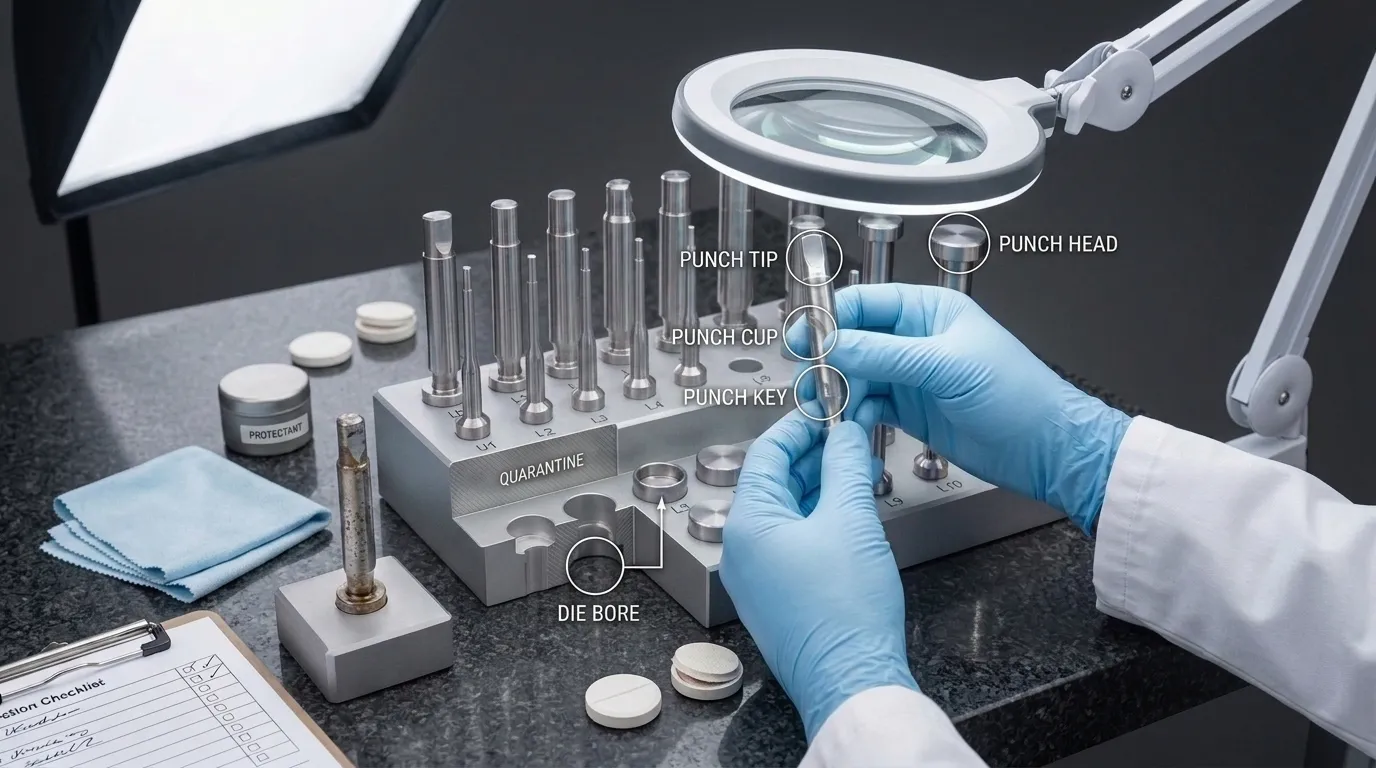
Storage controls can fail. Containers can leak, desiccants can become saturated, protectants can break down, labels can detach, and components can shift.
Inspection frequency should consider:
- Storage duration
- Tool material and coating
- Room stability
- Enclosure type
- Protectant instructions
- Desiccant condition
- Previous corrosion events
- Frequency of access
- Environmental excursions
Schedule Risk-Based Stored-Condition Checks
During a stored-condition review, check for:
- Corrosion or staining
- Visible moisture
- Dust or residue
- Damaged seals
- Exhausted desiccant
- Shifted or contacting components
- Insert deterioration
- Missing tools
- Incorrect labels
- Unexplained changes in status or location
Do not assign one universal monthly, quarterly, or annual interval. The inspection schedule should be documented and justified by the actual risk.
Complete a Pre-Use Release Check
Before installation:
- Confirm the tool-set identity and specification.
- Reconcile the component count.
- Inspect punch tips, cups, heads, keys, die edges, and die bores.
- Check for corrosion, discoloration, moisture, chips, and coating damage.
- Remove the storage protectant using the approved method.
- Re-clean the tooling when required.
- Confirm that the set has released status.
- Record completion of the inspection.
An intact box does not prove that the tooling inside is ready for production.
Avoid Common Tablet Tooling Storage Mistakes
| Mistake | Risk created | Better control |
| Storing tools while damp | Corrosion, staining, or contamination | Verify complete drying before protection |
| Applying oil over residue | Traps contamination and hides condition | Clean and inspect first |
| Using a shared loose bin | Impact, scratching, and mixed components | Use individual fitted positions |
| Using dirty or shedding foam | Particles, retained moisture, and abrasion | Use cleanable, compatible inserts |
| Assuming coated tools need no protection | Coating damage and exposed areas may still deteriorate | Follow coating-specific guidance |
| Leaving desiccant indefinitely | False confidence after saturation | Inspect and replace it according to the enclosure plan |
| Mixing released and quarantined sets | Accidental installation of unsuitable tooling | Use clear status and physical segregation |
| Ignoring temperature transitions | Condensation on cooler metal surfaces | Control equilibration and inspect after excursions |
| Returning tools directly from storage | Undetected damage, residue, or identity errors | Complete a documented pre-use release check |
Build the Storage Process Into the Tool-Room SOP
A repeatable tablet tooling storage procedure should define:
- Responsible personnel
- Approved cleaning and drying methods
- Inspection and status criteria
- Approved containers and insert materials
- Protectant selection and removal methods
- Facility-defined environmental limits
- Monitoring equipment and review frequency
- Storage-location control
- Required records
- Quarantine and escalation procedures
- Environmental-excursion response
- Pre-use release responsibility
- Training and change-control requirements
Regulations and guidance differ by market and application. Use FDA and WHO sources as applicable references, then align the final SOP with local requirements, the facility’s quality system, and supplier documentation.
Confirm Material-Specific Requirements With the Tooling Supplier
General storage guidance cannot replace material- and design-specific information. Before approving a protectant, insert, or long-term preservation method, confirm:
- The actual tool steel
- Surface coating or treatment
- Chemical restrictions
- Compatible protectants
- Approved removal methods
- Support requirements for delicate tips or embossing
- Any storage limitations for unusual geometries
SunshinePro’s tablet press tooling page identifies punches and dies, high-speed steel as an available material, and customization based on size, material, and press or mold pairing. The company also states that custom tooling can be processed from drawings or samples.
For material-specific questions, replacement tooling, or a custom punch-and-die requirement, contact SunshinePro with the tooling drawing, sample, material information, and application details.
Share:



Written By Sunshine
At Sunshine, we are a professional manufacturer and supplier of precision mould components, offering a wide range of products for stamping and injection mould applications. Our core focus includes punching dies, ejector pins and sleeves, and guide posts and bushings. With advanced CNC machining, strict quality control, and strong production capabilities, we ensure reliable, high-precision parts, along with in-stock standard components for fast and efficient global supply.
NEWS
GET SERVICE
With quality parts to meet every budget and friendly staff trained to make your visit informative and hassle free.
