



Future of Injection Molding: Trends, Technologies, and Industry Transformation
Digitalization, the need to be sustainable, and the accelerated development of automation are causing a significant change to the injection molding industry. What used to be a very mechanical and repeatable process in manufacturing is transforming to a data driven and intelligent production system. Smart factories, new materials, highly efficient production models that enhance quality and lower cost and environmental impact are the future of injection molding.
With the world manufacturing trending towards increased efficiency and flexibility, injection molding is still among the most significant processes in mass production of plastic components. But, its future will be very unlike its traditional roots.
Smart Industry and Manufacturing 4.0 Integration.
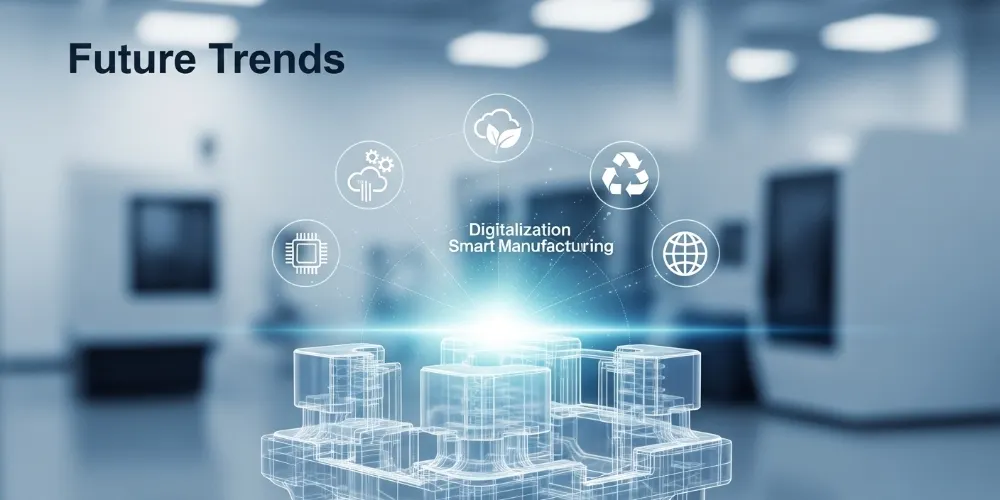
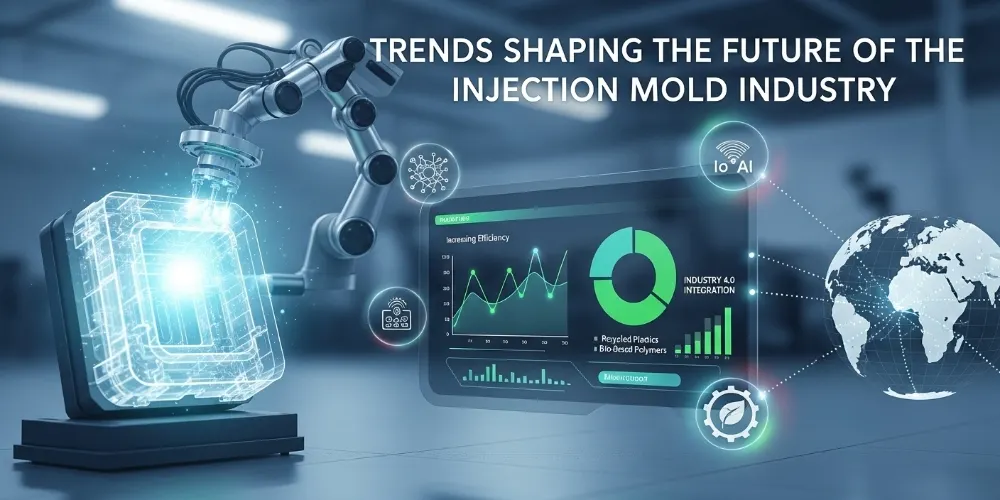
The adoption of Industry 4.0 technologies is one of the most influential developments that may affect the industry. The current injection molding machines are becoming more and more interconnected with the help of IoT sensors, cloud computing, and AI-based monitoring systems. These technologies enable manufacturers to monitor real time temperature, pressure, cycle time, and material flow.
Factories do not need to use manual inspection but can now utilize predictive analytics to identify possible defects in their production before they happen. The change enhances stability of production, minimizes waste and decreases downtime. Even in the most advanced plants, machines are able to automatically adjust the processing parameters during manufacturing in order to produce at the same level.
Digital twins are also on the rise and engineers can now simulate the whole process of molding virtually, before the real process is implemented. This minimizes trial and error in tooling, and accelerates product development cycles.
Lights-Out Manufacturing and Automation
The other major force that is influencing the future of injection molding is automation. Robots are finding widespread application in part removal, sorting, assembly and packaging. This saves the use of manual labor, enhances consistency and speed.
In more sophisticated manufacturing settings, Lights-out production is coming to fruition. This is the complete automation of factories that can be run with the bare minimum manpower, even at night. Machines talk to one another, automatically adjust, and keep on producing with minimal monitoring.
Automation can enhance safety at the workplace, as well, by decreasing the number of humans exposed to equipment of high temperatures and repetitive labor. With labor shortages persisting in most of the areas, automation is not only a benefit, but a requirement.
Environmentally-Conscious Materials and Production
The concept of sustainability is transforming the material choice and manufacturing approaches in injection molding. To minimize environmental impact, manufacturers are turning to recycled plastics, bio-based polymers and post-consumer resin (PCR) materials.
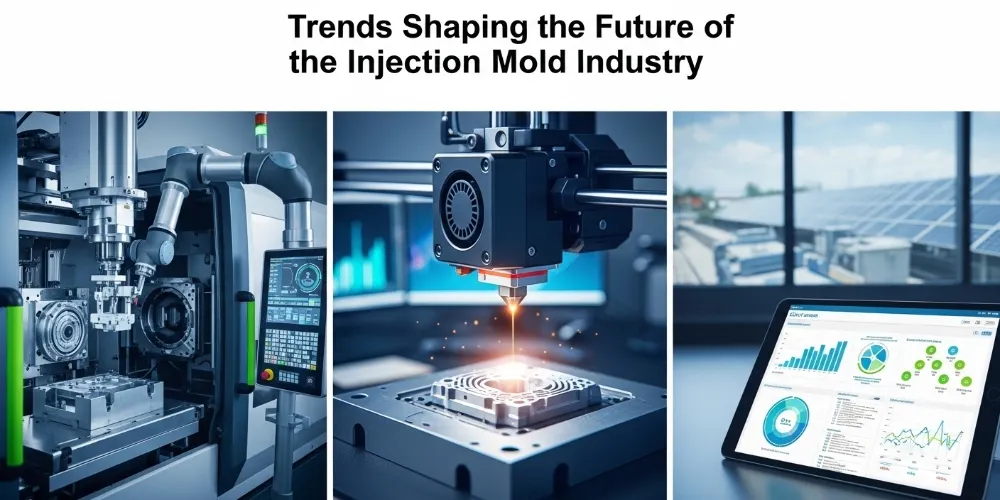
Meanwhile, industries are working on minimizing scrap levels and energy use in the production process. Electric injection molding machines, such as, are more efficient in electricity usage as compared to the traditional hydraulic systems and help to reduce carbon emissions.
Design possibilities are also increasing by material innovation. Engineering-grade thermoplastics are high-performance polymers that enable manufacturers to produce lighter, stronger and more durable components to the automotive, electronics, and medical devices industries.
High Technology and Fine Engineering
The future of injection molding is not just of sustainability, but also of performance. More complex uses are being facilitated by more advanced materials like fiber-reinforced plastics, polycarbonate blends and high heat resistant polymers.
Another fast growing industry is micro-molding. It enables the manufacturers to create very small and accurate components applied in medical equipment, electronics and wearable technology. These parts require extremely tight tolerances and advanced tooling systems.
The efficiency is also being enhanced by multi-cavity molds and conformal cooling systems. Such innovations assist in shortening cycle times, raising the level of consistency in cooling, and increasing the overall quality of the products.
Process Optimization and Artificial Intelligence
AI is increasingly becoming useful in streamlining injection molding. Artificial intelligence is used to process massive amounts of production data, showing trends and enhancing efficiency.
Machine learning algorithms have the potential to forecast machine wear, optimize the parameters of the cycle, and minimize the number of defects. In other instances the AI-based optimization systems may also modify the production conditions on the fly to ensure quality production with optimal output.
This data-driven solution can considerably mitigate human error and assist manufacturers to have more stable and profitable production processes.
Flexible Manufacturing and Supply Chain Shifts
The future of injection molding is also affected by the global supply chains. The trend of nearshoring or localized production is shifting in the direction of many companies in order to save on the cost of transport as well as enhance the speed of delivery.
There is an increased use of just-in-time manufacturing models whereby companies only manufacture parts when required instead of keeping large inventories. This decreases storage expenses and enhances the flexibility in reacting to market demand.
Flexible manufacturing systems also allow a quicker changeover of molds and smaller production batches, which make injection molding more appropriate to customized and on-demand production.
The Future Prospect of Injection Molding
Moving forward, injection molding will keep on becoming an intelligent and sustainable process of manufacturing. Combination of automation, AI, advanced materials and digital manufacturing systems will transform the way products are designed and manufactured.
Although the recent developments in 3D printing are growing in some regions, the injection molding is unrivaled in terms of scalability, accuracy, and cost-effectiveness in high volume production. Rather than being substituted, it is being enhanced into a smarter, quicker, and flexible manufacturing solution.
Injection molding is not only about the production of parts; it is about the creation of interrelated, intelligent and sustainable manufacturing processes that can respond to the needs of the modern industry.
With the trends evolving, organizations that adopt digital transformation and material innovation will be at the right position to dominate in the new era of manufacture.
Share:



Written By Sunshine
At Sunshine, we are a professional manufacturer and supplier of precision mould components, offering a wide range of products for stamping and injection mould applications. Our core focus includes punching dies, ejector pins and sleeves, and guide posts and bushings. With advanced CNC machining, strict quality control, and strong production capabilities, we ensure reliable, high-precision parts, along with in-stock standard components for fast and efficient global supply.
NEWS
GET SERVICE
With quality parts to meet every budget and friendly staff trained to make your visit informative and hassle free.
