



Tablet Punch Cup Depth Design: Shape, Force, and Defect Risk
Tablet punch cup depth helps determine the finished tablet’s face curvature, central band, and overall appearance. A deeper cup can create a more convex tablet, but it may also reduce punch-tip strength and increase sensitivity to capping, uneven density, or wear under certain operating conditions.
There is no universal best cup depth. The correct design depends on cup radius, tablet diameter, land geometry, required compression load, formulation behavior, and press conditions. Cup depth should therefore be evaluated as one part of the wider system of tablet press tooling types, not as an isolated dimension.
What Tablet Punch Cup Depth Measures
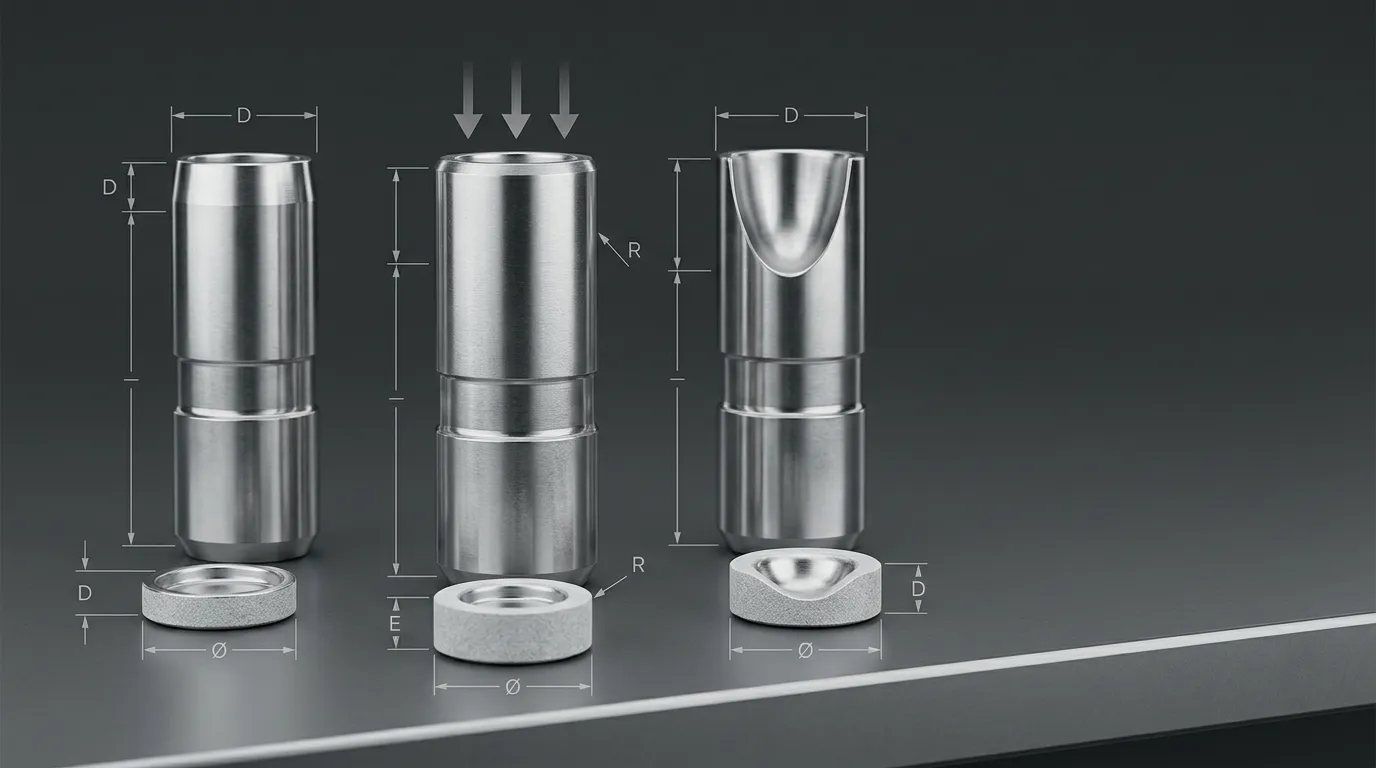
The punch cup is the recessed area at the end of the punch tip. During compression, the upper and lower cups form the two main faces of the tablet while the die bore forms its central band or sidewall.
Cup depth is the vertical distance from the highest reference surface of the punch tip to the lowest point of the cup. Identification features such as embossed or debossed letters should not be included in this measurement. This distinction follows the terminology used in the APhA Tableting Specification Manual.
Cup depth is also separate from punch working length. Working length influences compression position and tablet consistency, while cup depth defines the shape of the tablet face.
Cup Depth, Cup Radius, and Cup Volume Are Different Variables
Cup depth alone does not fully describe the punch profile.
| Variable | What it describes | Why it matters |
|---|---|---|
| Cup depth | The vertical distance from the reference surface to the lowest point of the cup | Influences face height, tablet convexity, and remaining punch-tip section |
| Cup radius | The curvature used to form the cup | Determines how gradually or sharply the face curves |
| Cup volume | The volume contained within the recessed profile | Affects how tablet volume is distributed between the faces and central band |
| R/D ratio | Cup radius divided by tablet diameter | Helps compare curvature across tablets of different sizes |
Two punches can have similar cup depths but different radii. One may use a smooth, broad curve, while another reaches the same depth through a steeper profile. Their tablet appearance, stress distribution, and punch-tip strength may therefore differ.
Compound cups make this distinction even more important. Instead of using one continuous radius, a compound profile combines two or more radii. This can create a smooth-looking tablet face while still producing a steep transition near the outer edge.
How Upper and Lower Cups Form the Tablet Band and Total Thickness
The finished tablet consists of three connected geometric regions:
- the upper cup-formed face;
- the lower cup-formed face;
- the central band formed inside the die.
For a given total tablet thickness, increasing the combined depth of the upper and lower faces generally leaves less thickness in the central band. A narrower band changes the tablet’s proportions and may influence die-wall contact, ejection behavior, and mechanical failure patterns.
Tablet diameter must also be considered. A 1 mm cup depth does not represent the same curvature on a small tablet and a large tablet. Diameter, radius, depth, and band thickness must be reviewed together.
Upper and lower cup profiles do not always have to match. A tablet may use symmetrical faces, or one side may be flatter to support branding, handling, coating, packaging, or application requirements. Any asymmetrical design should still be evaluated as one complete tablet geometry.
How Common Punch Cup Profiles Compare
The names used for cup profiles describe general forms rather than one universal set of dimensions. A “deep concave” profile from one tooling system or supplier may not have exactly the same depth or radius as another.
| Cup profile | General shape | Main design benefit | Main limitation or risk |
| Flat face | Flat tablet surface | Simple geometry and relatively direct loading | May not provide the required appearance or handling characteristics |
| Flat-faced bevel edge, or FFBE | Flat centre with an angled edge | Defines the tablet edge and can reduce a sharp corner | Bevel geometry affects the outer tip section and tablet edge |
| Flat-faced radius edge, or FFRE | Flat centre with a rounded edge | Provides a smoother edge transition | Radius details still affect stress and compact behavior |
| Shallow concave | Slightly convex tablet face | Provides curvature while preserving a relatively substantial central band | May not meet a strongly convex appearance requirement |
| Standard concave | Moderate face curvature | Balances appearance and general tooling practicality | “Standard” does not represent one universal dimension |
| Deep concave | Strongly convex face | Creates a more pronounced tablet profile | Can reduce punch-tip force capacity and increase sensitivity to capping |
| Extra-deep concave | Highly convex face | Supports a distinctive rounded tablet shape | Produces more aggressive geometry and requires careful force and formulation review |
| Compound cup | Face created from multiple radii | Allows more control over appearance and edge shape | Depth alone cannot describe its stress or strength implications |
A profile should not be selected solely from this classification. The actual drawing must specify the relevant depth, radius or radii, land, edge transition, tablet diameter, and total thickness.
Why Deeper Cup Geometry Can Reduce Punch Force Capacity
The tablet press may be capable of applying a high compression force, but that does not mean every punch-tip design can safely carry that load.
A deeper or steeper cup removes more material from the punch-tip region and changes the path through which compression load passes. The allowable force can depend on:
- tip diameter and shape;
- cup depth and radius;
- single-radius or compound geometry;
- land width and transition geometry;
- punch material and heat treatment;
- existing wear or damage;
- the safety margin applied by the tooling designer.
Specialist tooling guidance consistently warns that machine capacity and punch-tip capacity are separate limits. A tooling design should therefore receive a drawing-specific force assessment rather than relying only on a generic press rating or tooling class.
SunshinePro lists Premium High-Speed Steel for its tablet press tooling. Material is one contributor to strength, but it does not replace a geometry-specific review of the punch tip.
How Land and Cup-to-Edge Transitions Affect Tip Strength
The land is the narrow flat area around the perimeter of the punch tip. It provides support at the edge of the cup and influences wear, flashing, and tablet-band appearance.
A wider or better-supported land may improve edge strength, but changing it can also alter the tablet profile. The transition between the cup and land matters as well. A smooth blend radius generally creates a less abrupt geometric change than a sharp corner.
These details cannot be selected independently:
- Cup depth affects how much material remains beneath the recessed face.
- Land width affects edge support.
- The blend radius affects the transition between the cup and land.
- Tablet appearance limits how much these features can be changed.
There is no universal minimum land width. The correct value depends on the punch shape, material, compression requirement, tablet appearance, and tooling standard.
Compression Force, Pressure, Breaking Force, and Tensile Strength
Several different measurements are used in tablet design, and they should not be treated as synonyms.
| Term | Meaning |
| Compression force | The load applied by the tablet press, commonly expressed in kilonewtons |
| Compression pressure | Force divided by an applicable area, commonly expressed in megapascals |
| Tablet breaking force | The measured force required to break a finished tablet in a defined test |
| Tensile strength | A geometry-adjusted measure used to compare the mechanical strength of tablets |
Compression pressure is often used in research because the same force produces different pressure conditions on tablets with different face areas.
Breaking force is a direct test result. Tensile strength attempts to account for tablet dimensions and geometry, making it more useful for some comparisons. Highly convex or unusual profiles may require an equation appropriate to that geometry rather than a formula developed for a flat cylindrical tablet.
How Cup Depth Influences Tablet Mechanics and Defect Risk
During compression, powder does not densify uniformly in every region of a tablet. Punch shape affects how material moves, how pressure is transmitted, and where density or stress gradients develop.
Finite-element and experimental studies have found that convex punch profiles can produce more heterogeneous density distributions than flat punches. Reduced curvature radius and changes in tablet thickness may increase those gradients under the conditions studied. The effect is important because regions with different density or residual stress may respond differently during decompression and ejection.
These findings are directional, not universal. The actual result also depends on formulation properties, compression pressure, speed, lubrication, air release, tablet diameter, and band thickness.
Why Capping Risk Cannot Be Predicted From Depth Alone
Capping occurs when part of the upper or lower crown separates from the tablet body. Research published in Pharmaceutical Research found that increasing punch cup depth was associated with a higher capping index in the studied acetaminophen formulation and compression conditions.
A separate study in the International Journal of Pharmaceutics showed that tablet diameter, band thickness, curvature ratio, and their interactions influenced capping behavior. Greater curvature, a thinner band, and larger diameter increased capping susceptibility in that experimental system.
These studies do not prove that every deep cup will cap. They show that geometry can increase risk when combined with particular material and process conditions.
Cup-depth assessment should therefore include:
- tablet diameter;
- upper and lower curvature;
- central band thickness;
- formulation compactibility;
- elastic recovery;
- target compression pressure;
- press speed and air-release conditions;
- existing capping history.
A shallower cup may reduce one geometric risk while failing to meet appearance, coating, handling, or dosage-form requirements. The design decision is a trade-off, not a simple ranking.
Distinguishing Capping, Lamination, Air Entrapment, and Tool Wear
Not every separation defect is caused by the cup profile.
| Observation | Possible geometry-related cause | Other possible cause | What to verify |
| Crown separates from the tablet | Aggressive curvature, thin band, stress concentration | Elastic recovery, entrapped air, unsuitable pressure or speed | Failure location, cup profile, formulation response, press conditions |
| Tablet separates through an internal plane | Uneven density or stress distribution | Lubrication, formulation weakness, air pressure | Fracture plane, density pattern, material and process history |
| Thin material appears around the tablet band | Damaged or worn land, clearance issue | Die wear, alignment, excessive force | Punch edge, land condition, die bore, alignment |
| Defects increase after extended tool use | Effective cup or land geometry has changed | Process drift or formulation variation | Compare worn tools with original inspection records |
| Local damage appears near the tablet edge | J-hooking or damaged punch edge | Handling or ejection issue | Magnified tip inspection and ejection behavior |
Entrapped air is one important non-geometric factor. Research in the Journal of Pharmaceutical Sciences shows that internal air pressure can rise during compression and contribute to cracking or capping. Powder permeability, compression speed, tablet size, and consolidation behavior all affect this mechanism.
How to Select Cup Depth for a New or Revised Tablet
A useful selection process begins with the required tablet, not with a preferred punch profile.
- Define the finished tablet shape and dimensional limits.
- Select depth and radius together.
- Review the remaining band and edge geometry.
- Estimate the required production compression conditions.
- Confirm the allowable force for the proposed punch tip.
- Review formulation and process sensitivity.
- Compare less aggressive alternatives.
- Validate the final design through compression trials and inspection.
Start With the Required Tablet Shape and Band
Document the dimensions and functional requirements before choosing the cup profile:
- tablet diameter or major and minor axes;
- target total thickness;
- required band thickness;
- upper and lower face shape;
- edge style;
- coating and handling requirements;
- branding or identification area;
- packaging and feeding constraints.
The design team should then determine whether the appearance can be produced with a broader radius or shallower depth. A small geometric change may preserve the visual profile while increasing punch-force margin or reducing capping sensitivity.
Upper and lower profiles should also be assessed separately. A symmetrical tablet may be visually desirable, while an asymmetrical tablet may provide a flatter identification surface or better handling characteristics.
Check Formulation and Process Sensitivity
The same cup geometry can behave differently with two formulations. Relevant material properties include:
- compactibility;
- plastic or brittle deformation behavior;
- elastic recovery;
- permeability;
- lubricant sensitivity;
- moisture condition;
- previous capping or lamination history.
Press conditions matter as well. Precompression may assist air release and early consolidation, while press speed affects the time available for densification and decompression. Detailed consolidation-time decisions belong to tablet punch head flat and dwell time, but cup depth should still be reviewed alongside those conditions.
Geometry cannot automatically compensate for a formulation that does not form a stable compact. It also should not be changed before confirming that the defect is not being caused by air entrapment, lubrication, pressure, speed, alignment, or worn tooling.
Confirm Tooling Force Margin and Validate the Final Design
Before manufacturing the full tooling set, confirm:
- the press and tooling standard;
- the proposed upper and lower cup drawings;
- the material and heat-treatment specification;
- the expected operating-force range;
- the allowable punch-tip force for the proposed geometry;
- the required safety margin;
- the cup, land, radius, and working-length tolerances;
- the trial and acceptance criteria.
Production trials should use the actual formulation, intended press, realistic operating speed, and expected pressure range. Evaluation should include tablet dimensions, appearance, breaking behavior, capping, lamination, ejection, and punch condition.
A profile is ready for approval only when both sides of the design are acceptable: the punch can withstand the operating conditions, and the formulation can produce a stable tablet with the required shape.
What to Specify on the Punch Drawing and RFQ
A tooling supplier cannot assess cup depth from a tablet image alone. The RFQ should separate the required tablet geometry from the tooling, press, and production conditions.
SunshinePro states that custom tablet tooling can be processed from drawings or samples and that its workflow includes drawing submission, design review, quotation, production, inspection, and delivery. A controlled drawing remains the clearest way to define the required geometry.
Geometry and Application Information to Include
| Information | Why it matters |
| Tablet diameter or major and minor axes | Establishes the scale of the face geometry |
| Target total thickness | Defines the complete finished profile |
| Required band thickness | Controls the central sidewall and die-contact region |
| Upper and lower cup depths | Defines each face independently |
| Cup radius or compound radii | Describes curvature rather than depth alone |
| Land width | Defines punch-edge support and tablet edge |
| Blend or transition radius | Controls the cup-to-land transition |
| Edge style | Affects the tablet edge and punch geometry |
| Embossing or debossing | Changes local geometry and identification features |
| Tablet press and tooling standard | Confirms physical compatibility |
| Expected force or pressure range | Supports tooling-strength review |
| Formulation and known defect history | Identifies application-specific risks |
| Surface and inspection requirements | Establishes acceptance criteria |
A supplier should also know whether an existing tablet or punch sample is being reproduced. A sample may help communicate shape, but it should not replace a controlled drawing when exact depth, radius, land, and tolerance matter.
Tolerance, Inspection, and Documentation Requirements
Feature-specific tolerances should be agreed on the drawing. A general supplier capability does not prove that every cup feature can or should use the same tolerance.
Define how the following will be checked:
- upper and lower cup depth;
- cup radius or profile;
- land width;
- tip dimensions;
- working length;
- overall length;
- consistency across the punch set;
- material identification;
- final inspection records.
SunshinePro’s tablet tooling page publishes a general tolerance capability of ±0.002 mm and states that material inspection reports can be provided. That figure should still be confirmed against the actual cup feature, drawing geometry, inspection method, and production requirement.
Its stated quality-control approach includes raw-material inspection, in-process monitoring, final testing, and inspection reporting. Buyers should specify which records are required for the particular tooling order.
How Wear Can Change Effective Cup Depth and Defect Risk
An approved cup design can change during production life.
Repeated polishing may gradually reduce effective cup depth, alter the radius, narrow the land, or round the edge transition. Uneven wear across a punch set can also produce differences in tablet thickness or face shape.
Common wear-related warning signs include:
| Production symptom | Tooling check |
| Tablet face becomes less defined | Compare cup depth and profile with the approved drawing |
| Tablet-band appearance changes | Inspect land width, edge transition, and die condition |
| Capping appears after a period of stable production | Check for J-hooking, worn land, altered cup geometry, and process drift |
| Dimensions vary by station | Compare punches across the complete set |
| Flashing appears around the band | Inspect punch-tip edges, die clearance, wear, and alignment |
J-hooking occurs when the punch-tip edge becomes deformed or develops a hooked profile. This damaged edge may disturb tablet release and contribute to capping, lamination, or flashing.
Before redesigning the cup, compare the current tooling with its original measurement and inspection records. A design that performed correctly when new may be experiencing a maintenance or wear problem rather than a fundamental geometry error.
Common Cup-Depth Design Mistakes
- Selecting depth from tablet appearance alone
Appearance does not reveal punch-tip strength, density distribution, or formulation sensitivity. - Treating depth and radius as interchangeable
Two profiles with the same depth can have different curvature and stress behavior. - Ignoring tablet diameter
A fixed depth has a different meaning on different tablet sizes. - Ignoring the central band
Deeper faces may reduce band thickness and change mechanical behavior. - Using machine capacity as the punch-force limit
The press may be able to apply more load than the punch tip can safely withstand. - Leaving land and transition details undefined
The cup edge is part of the structural design, not a minor finishing feature. - Assuming all deep cups cause capping
Depth may increase susceptibility, but formulation and process conditions determine the actual result. - Assuming shallow cups eliminate defects
Capping and lamination can still result from air, elastic recovery, lubrication, pressure, wear, or other causes. - Copying a profile from another tablet diameter
The depth-to-diameter and radius-to-diameter relationships may be different. - Ignoring tool wear
A worn punch may no longer match the approved cup profile. - Applying a general tolerance to every feature
Cup depth, radius, land, and working length may require different controls. - Approving the drawing without production-relevant trials
Dimensional correctness does not prove formulation compatibility.
When to Involve a Tablet Tooling Supplier
Supplier review is useful when the cup is deep, compound, asymmetrical, unusually small, intended for high compression load, or associated with recurring tablet defects. It is also appropriate when an existing punch or tablet sample must be reproduced.
SunshinePro’s tablet press tooling page confirms punches and dies, Premium High-Speed Steel, standard and non-standard size options, and customization based on drawings or samples. It also states that material inspection reports are available.
Before placing an order, request drawing-specific confirmation of:
- upper and lower cup geometry;
- material;
- feature tolerances;
- press and tooling compatibility;
- inspection method;
- documentation;
- allowable punch-tip force.
SunshinePro does not publicly confirm formulation testing, finite-element analysis, capping trials, or pharmaceutical-process validation. Those requirements should be discussed and verified separately rather than assumed from its general tooling capabilities.
Once the tablet geometry, expected operating conditions, and inspection requirements are defined, submit the tooling drawing or sample for manufacturing review and quotation.
Share:



Written By Sunshine
At Sunshine, we are a professional manufacturer and supplier of precision mould components, offering a wide range of products for stamping and injection mould applications. Our core focus includes punching dies, ejector pins and sleeves, and guide posts and bushings. With advanced CNC machining, strict quality control, and strong production capabilities, we ensure reliable, high-precision parts, along with in-stock standard components for fast and efficient global supply.
NEWS
GET SERVICE
With quality parts to meet every budget and friendly staff trained to make your visit informative and hassle free.
