



Automotive Plastic Molding: Interior, Exterior, and Structural Part Guide
Automotive plastic molding is used to produce interior, exterior, and structural vehicle components with different tooling, material, and durability requirements. Interior parts focus on cosmetic finish quality, exterior parts need UV and impact resistance, and structural components require reinforced materials, tighter tolerances, and stronger mold engineering for long-term performance.
Modern vehicles depend on molded plastic parts far beyond simple trim pieces. Dashboards, bumpers, battery housings, brackets, and under-hood assemblies all rely on different tooling strategies and material choices. That’s why automotive suppliers don’t treat every mold the same way. A cosmetic dashboard panel and a structural EV battery housing may use similar molding processes, but their engineering priorities are completely different.
What is automotive plastic molding?
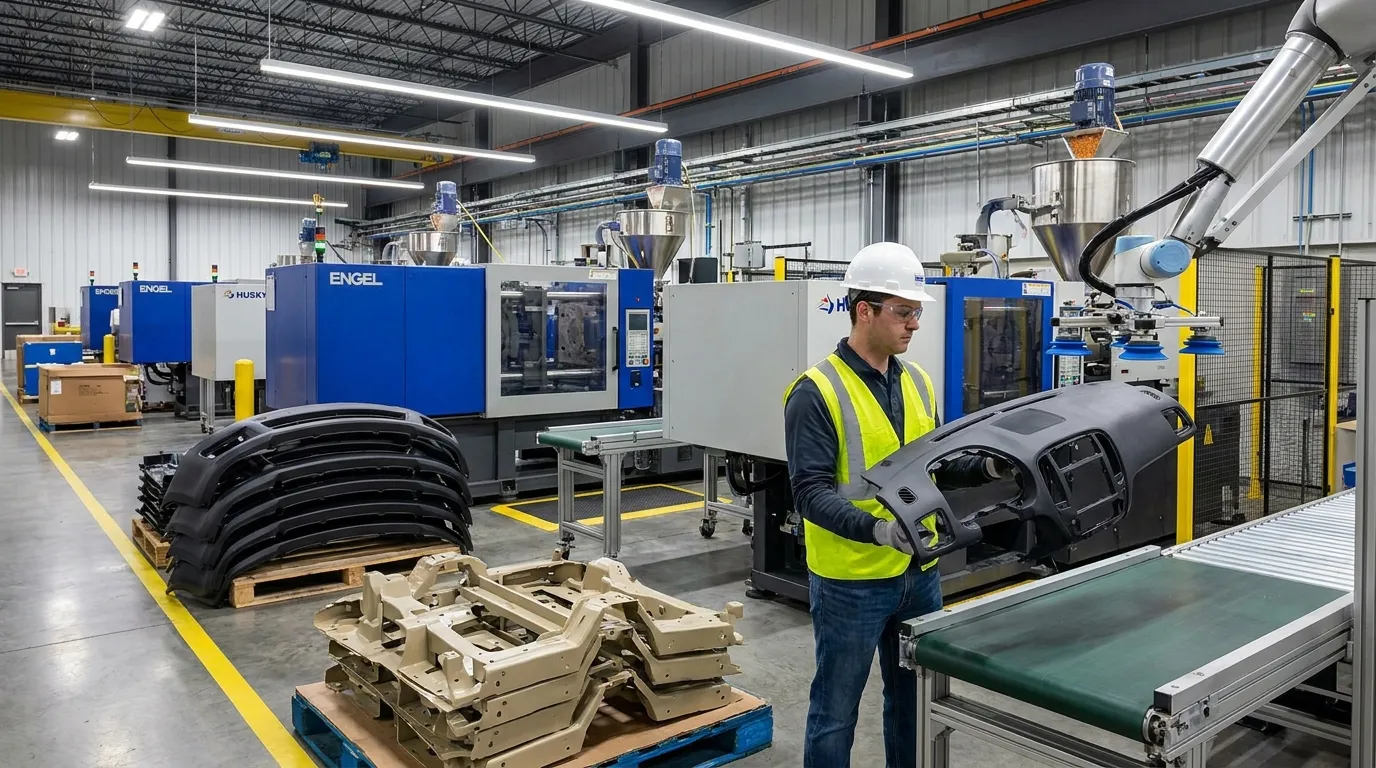
Automotive plastic molding uses injection molds to mass-produce precise vehicle components with repeatable quality. It is widely used for dashboards, bumpers, housings, trims, and structural support parts because it supports complex geometries, lightweighting, and scalable production.
Automotive injection molding works by forcing molten plastic into a precision mold cavity under pressure. After cooling, the part ejects with consistent dimensions and repeatable geometry. This process supports high-volume production with tight tolerances, which is essential for vehicle manufacturing.
Car manufacturers use molded plastics because they reduce weight and support complex part designs that would be difficult or expensive with metal. According to the U.S. Environmental Protection Agency, plastics are widely used across transportation applications because they balance durability, flexibility, and manufacturing efficiency.
Interior trim pieces, exterior panels, clips, housings, and structural supports all use different tooling strategies. Companies sourcing automotive molding solutions often focus on repeatability, surface quality, and production scalability before anything else.
Which automotive parts are commonly injection molded?
Automotive injection molding is commonly used for dashboards, door panels, bumper covers, grilles, battery housings, clips, brackets, and engine-compartment components. Different part categories require different materials, mold tolerances, cooling strategies, and surface finishes.
Automotive parts usually fall into three main categories: interior, exterior, and structural components. Each category places different demands on mold engineering, resin selection, and production control.
| Part Category | Common Parts | Main Priority | Typical Materials | Tooling Complexity |
|---|---|---|---|---|
| Interior | Dashboards, consoles, door panels | Cosmetic quality | ABS, PP blends | Medium |
| Exterior | Bumpers, grilles, mirror housings | UV and impact resistance | PP, PC blends | Medium to high |
| Structural | Battery housings, brackets, supports | Strength and dimensional stability | Glass-filled nylon | High |
Interior parts focus heavily on appearance. Exterior components must survive heat, moisture, road debris, and sunlight. Structural parts handle mechanical loads and often require reinforced materials.
Many manufacturers producing molded automotive components separate tooling strategies based on these application groups early in the DFM process. That helps reduce costly redesigns later in production.
How do interior automotive parts affect mold design?
Interior automotive molds prioritize cosmetic consistency, texture accuracy, and dimensional stability. Dashboard panels, trim pieces, and console components require tight surface-quality control because visible defects immediately affect perceived vehicle quality.
Interior parts may not handle structural loads, but they often create the highest cosmetic expectations. A small weld line or sink mark on a dashboard panel can become immediately visible to vehicle buyers. That changes how tooling engineers design gates, cooling systems, and surface textures.
Dashboard molds, for example, often require highly controlled cooling to reduce warpage across large flat surfaces. Interior trim pieces also need consistent texture replication. Uneven gloss levels or inconsistent grain patterns can make production parts look mismatched inside the vehicle cabin.
Common cosmetic defects in automotive interiors
- Sink marks near ribs or mounting points
- Visible weld lines around openings
- Warpage on long trim components
- Gloss inconsistency across textured surfaces
- Flash around snap-fit features
Cosmetic automotive parts are usually harder to perfect than many structural parts. Structural components can tolerate minor visual variation, but interior trim cannot. That’s why mold polishing, venting, and cooling balance become major priorities during tooling development.
A textured dashboard mold and a painted bumper mold illustrate this difference clearly. The dashboard tool focuses on texture consistency and low distortion, while the bumper mold focuses more on impact resistance and dimensional stability during assembly.
For readers who want deeper tooling fundamentals, this injection mold design basics resource explains broader mold engineering concepts in more detail.
What changes for exterior automotive plastic parts?
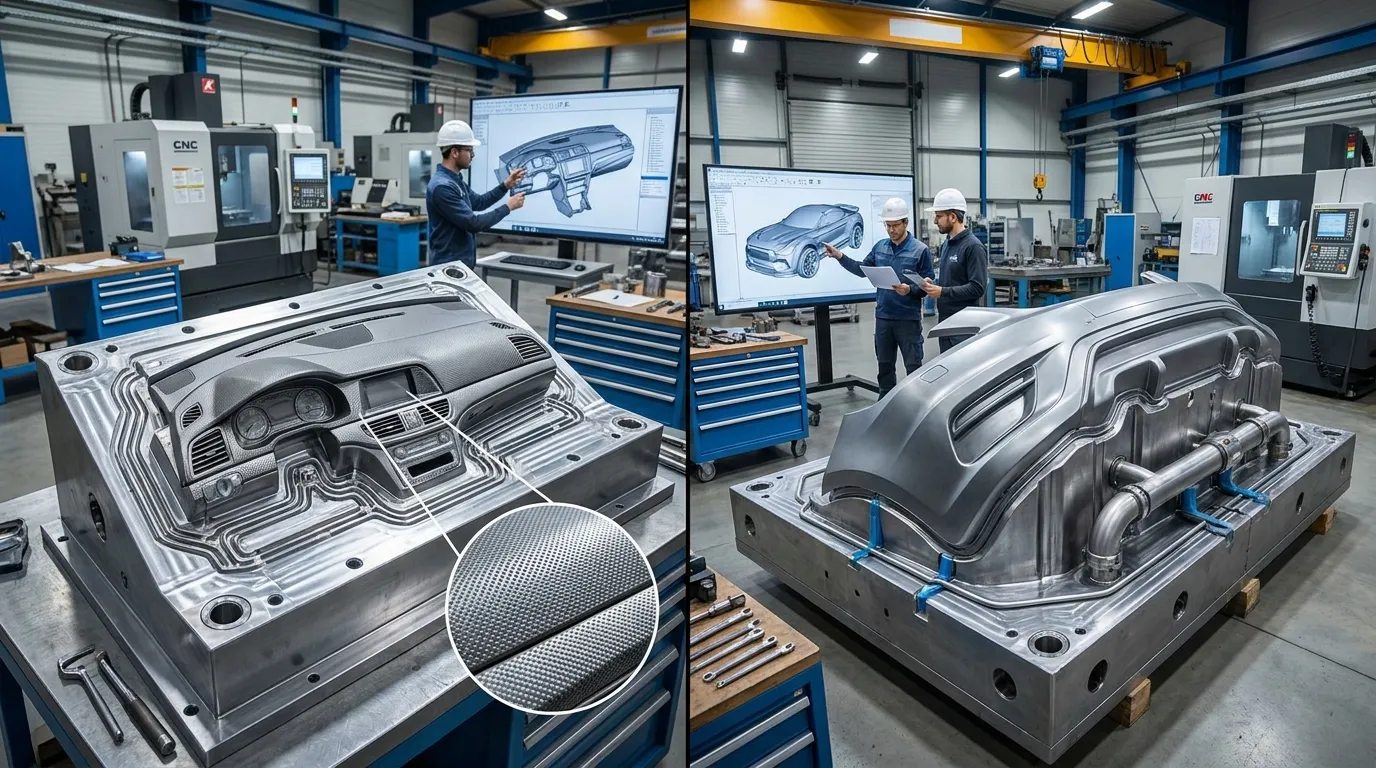
Exterior automotive parts require molds that support durable finishes, impact-resistant materials, and stable dimensions under heat and UV exposure. Bumpers, grilles, and mirror housings often require larger tooling systems and stricter process consistency.
Exterior automotive parts deal with far harsher environments than interior components. Heat, moisture, sunlight, road debris, and temperature swings all affect material selection and tooling requirements. Molds for these parts must support stable processing over long production runs.
Large exterior components also create cooling challenges. A bumper cover, for example, requires balanced cooling across a wide mold surface to reduce distortion. Poor cooling balance can create uneven shrinkage and assembly problems during vehicle production.
Why bumper molds differ from dashboard molds
| Bumper Mold Priority | Dashboard Mold Priority |
|---|---|
| Impact resistance | Surface texture consistency |
| UV durability | Cosmetic grain accuracy |
| Paint adhesion | Low gloss variation |
| Large-part dimensional stability | Tight visible fit lines |
Exterior molds also require attention to paintability and surface durability. Some exterior parts use textured finishes, while others require Class A surfaces that support high-quality painting.
Lower tooling quotes are not always cheaper long term. Exterior molds with weak cooling systems or lower-grade steel may struggle with large-part consistency after extended production cycles. That often leads to higher maintenance costs and slower production later.
Teams sourcing automotive injection molding process support often evaluate tooling durability alongside upfront cost for this reason.
How do mold requirements change for structural automotive parts?
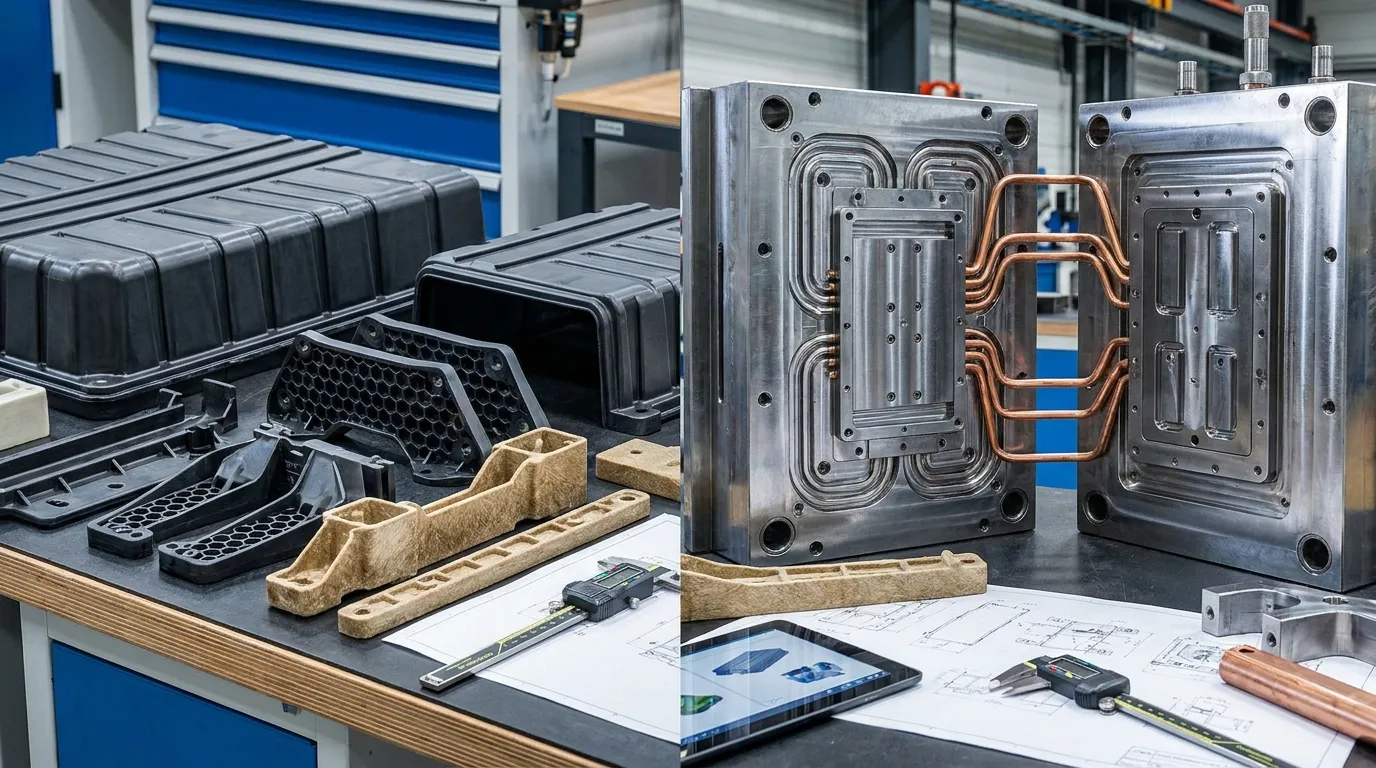
Structural automotive plastic parts require stronger materials, tighter engineering validation, and more durable tooling than cosmetic components. Battery housings, brackets, and under-hood supports must maintain strength, dimensional stability, and long-term performance under stress.
Structural parts create different engineering priorities because they carry loads or support critical assemblies. These parts often use reinforced engineering plastics that increase mold wear and processing complexity.
Glass-filled nylon is a common example. It improves stiffness and heat resistance, but the abrasive glass fibers wear mold surfaces faster than standard polypropylene. Buyers focused only on part strength sometimes underestimate how quickly reinforced materials can increase tooling maintenance requirements.
Common materials for structural automotive components
| Structural Requirement | Common Material | Tooling Impact |
|---|---|---|
| Heat resistance | Glass-filled nylon | Higher mold wear |
| Dimensional stability | PC blends | Tight cooling control |
| Impact strength | Reinforced PP | Larger gate requirements |
| Electrical insulation | Engineering thermoplastics | Precision tolerance control |
EV battery housings are a good example of structural complexity. These components require dimensional stability across large surfaces because small variations can affect sealing performance or assembly alignment.
Snap-fit console clips and large structural battery supports also show very different tooling demands. The clip mold may focus on tiny tolerance control and fast cycles, while the battery housing mold may prioritize cooling efficiency and long-term dimensional stability across a much larger cavity.
Many engineering teams use a complete mold component guide when evaluating tooling durability, cooling systems, and cavity design for reinforced materials.
Which plastics are commonly used for automotive parts?
Automotive manufacturers choose plastics based on heat resistance, impact strength, UV exposure, chemical resistance, and cosmetic requirements. Polypropylene, ABS, nylon, and reinforced engineering plastics are commonly selected for different automotive applications.
Material selection changes based on where the part sits in the vehicle and what conditions it must survive. Interior trim parts may prioritize appearance and low cost, while under-hood parts require heat resistance and structural strength.
| Material | Common Automotive Use | Main Benefit |
|---|---|---|
| Polypropylene (PP) | Bumpers, trims, panels | Lightweight and cost-effective |
| ABS | Dashboards, interior trim | Good cosmetic finish |
| Polycarbonate blends | Exterior housings | Impact resistance |
| Nylon (PA) | Structural brackets | Strength and heat resistance |
| Glass-filled nylon | Under-hood supports | High stiffness |
According to Plastics Europe, engineering plastics help reduce vehicle weight while supporting durability and manufacturing efficiency.
Glass-filled materials are not always the safest choice. They work well for high-strength applications, but they also accelerate mold wear significantly. For some medium-load parts, reinforced polypropylene may provide a better balance between tooling life and mechanical performance.
What production problems commonly affect automotive molded parts?
Automotive molded parts often fail because of cooling imbalance, shrinkage variation, poor venting, or inconsistent process control. Even small dimensional shifts can create assembly issues when parts must align with surrounding vehicle components.
Warpage is especially common in large parts like door panels and bumper covers. Uneven cooling rates across the mold cavity can cause twisting or dimensional distortion after ejection. Sink marks also appear frequently around ribs and thicker wall sections.
Why automotive tolerances increase defect risk
- Warpage on long components
- Sink marks near structural ribs
- Flash around shutoff areas
- Weld lines around openings
- Inconsistent shrinkage across cavities
Automotive tolerances increase risk because molded parts often interact with metal fasteners, electronic assemblies, or visible body gaps. Small dimensional changes can affect fit, appearance, or assembly speed.
A supplier choosing lower-cost cooling layouts may reduce upfront tooling expenses, but poor cooling balance often creates higher rejection rates later. According to this defect classification study, production defects remain a major focus area for automated quality inspection systems.
Readers evaluating recurring quality issues in automotive molding defects often focus on cooling consistency, resin control, and cavity balance first.
How should buyers evaluate an automotive molding supplier?
Buyers should evaluate automotive molding suppliers based on tooling engineering capability, automotive quality systems, material expertise, production scalability, and communication transparency. The lowest tooling quote is not always the safest long-term manufacturing decision.
Automotive tooling projects involve more than part pricing. Buyers should evaluate whether the supplier understands production consistency, mold maintenance, reinforced materials, and automotive dimensional requirements before approving tooling.
Lead time transparency also matters. According to Aprios Insights, tooling complexity can significantly affect production timelines. Structural molds with large cavities or reinforced materials usually require more engineering validation and testing.
Automotive Mold Decision Checklist
| Evaluation Area | What Buyers Should Check |
|---|---|
| Automotive experience | Previous automotive production programs |
| Material expertise | Experience with reinforced engineering plastics |
| Tooling quality | Steel selection, cooling design, maintenance planning |
| Production scalability | Ability to support volume growth |
| Communication | DFM feedback and timeline clarity |
| Quality systems | Inspection process and dimensional controls |
Nearshoring and mold transfer flexibility are becoming more important for automotive sourcing teams. Fictiv’s manufacturing trends report highlights growing pressure around supply chain resilience and tooling adaptability.
Companies with broader precision manufacturing experience often bring stronger process discipline to automotive programs, especially for high-tolerance components.
Getting the Next Step Right
Automotive plastic molding works best when tooling strategy matches the part’s real application requirements. Cosmetic interior panels, exterior body parts, and structural supports all demand different engineering priorities, material choices, and production controls.
If you’re sourcing automotive molds, focus on long-term production stability instead of only upfront tooling cost. Cooling balance, material compatibility, dimensional control, and mold durability usually affect total manufacturing cost far more than the initial quote. A supplier that understands those tradeoffs can help prevent expensive quality and maintenance problems later.
Frequently Asked Questions
What plastics are used in automotive injection molding?
Automotive injection molding commonly uses polypropylene, ABS, nylon, polycarbonate blends, and glass-filled engineering plastics. Material selection depends on heat exposure, cosmetic requirements, structural load, UV resistance, and long-term durability.
What automotive parts are injection molded?
Many dashboards, bumpers, grilles, door panels, battery housings, clips, brackets, and interior trim components are injection molded. The process supports high-volume production with consistent dimensions and repeatable quality.
What is the best plastic for automotive exterior parts?
Exterior automotive parts often use polypropylene blends, ABS blends, or reinforced engineering plastics because they resist UV exposure, heat, moisture, and impact damage. The best material depends on the part’s mechanical and cosmetic requirements.
How durable are automotive plastic parts?
Automotive plastic parts can last for years when the correct resin, tooling design, and processing controls are used. Structural and under-hood components typically require reinforced materials and stricter validation testing.
How long do automotive injection molds last?
Automotive injection molds can last hundreds of thousands or even millions of cycles depending on steel quality, material abrasiveness, and maintenance practices. Structural and glass-filled applications usually create faster mold wear.
Why is plastic used in modern vehicles?
Plastics help reduce vehicle weight, support complex geometries, improve fuel efficiency, and lower manufacturing costs compared with many metal alternatives. They also allow faster high-volume production.
Share:



Written By Sunshine
At Sunshine, we are a professional manufacturer and supplier of precision mould components, offering a wide range of products for stamping and injection mould applications. Our core focus includes punching dies, ejector pins and sleeves, and guide posts and bushings. With advanced CNC machining, strict quality control, and strong production capabilities, we ensure reliable, high-precision parts, along with in-stock standard components for fast and efficient global supply.
NEWS
GET SERVICE
With quality parts to meet every budget and friendly staff trained to make your visit informative and hassle free.
