



Medical Injection Molding: Requirements, Materials, and QC Checklist
Medical injection molding produces plastic medical components under stricter cleanliness, validation, and quality-control standards than standard molding. Manufacturers use materials like polypropylene, polycarbonate, TPU, and PEEK while following ISO 13485 workflows, traceability controls, and documented inspection procedures. Cleanroom production, mold validation, and detailed QC checkpoints help reduce contamination, dimensional defects, and regulatory risk in medical device manufacturing.
Medical devices need consistent quality, predictable performance, and reliable documentation. A small molding defect can affect assembly, sterilization, or patient safety. That’s why medical molding projects involve tighter process controls than standard commercial production. This guide explains how medical injection molding works, which materials are commonly used, and what buyers should check before approving tooling or production.
What is medical injection molding?
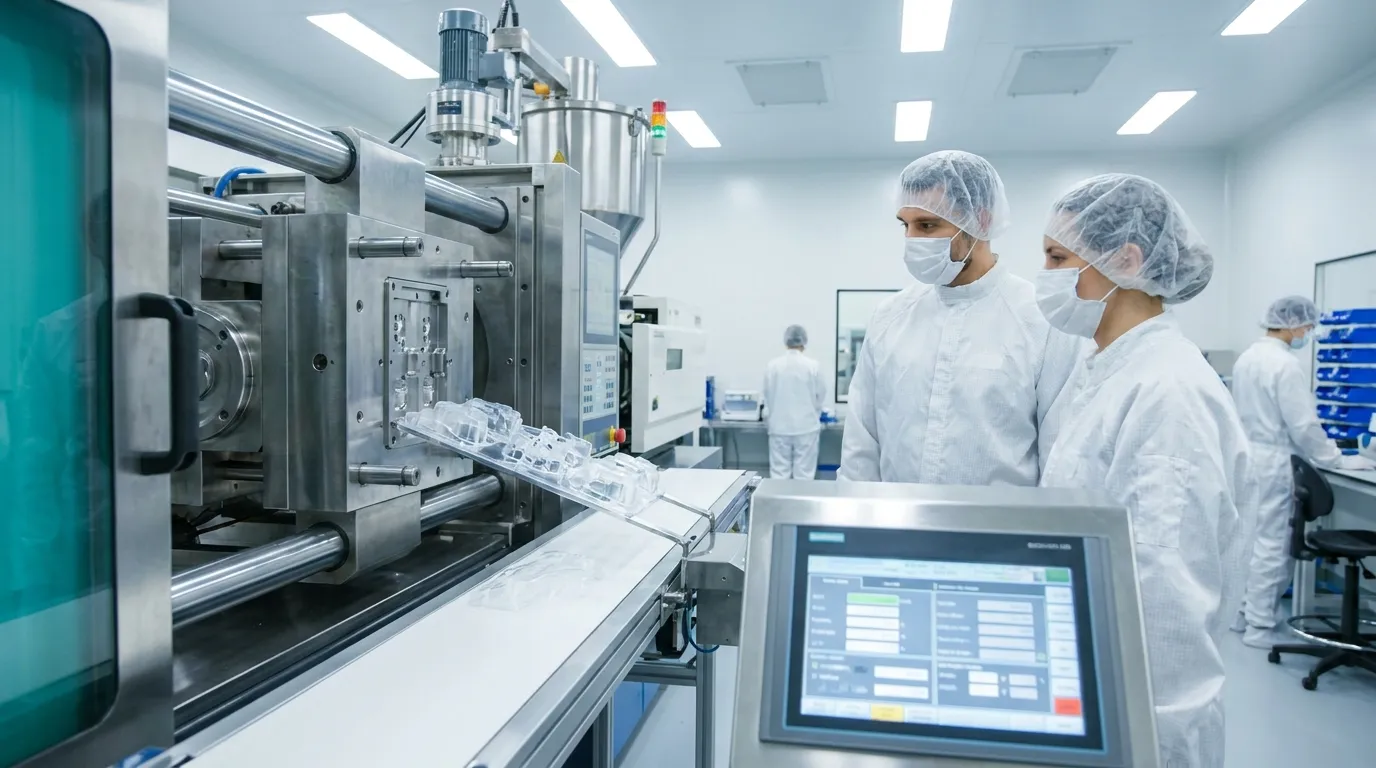
Medical injection molding produces plastic medical components under stricter quality, traceability, and cleanliness standards than standard molding. It is commonly used for syringes, diagnostic housings, surgical tools, and implant-support components that require repeatable precision and validated manufacturing controls.
Medical injection molding is a manufacturing process used to produce healthcare and medical device components with high consistency. The process injects melted plastic into a mold cavity, then cools and ejects the finished part. What changes in medical production is the level of control around materials, inspection, documentation, and contamination prevention.
Many disposable and reusable healthcare products rely on molded plastic parts. Common examples include syringe housings, IV connectors, diagnostic device enclosures, inhaler components, and surgical handles. These parts often require tight tolerances because dimensional variation can affect sealing, assembly, or sterilization.
Manufacturers also maintain stronger process documentation than in standard molding projects. Material batches, inspection records, and validation reports are usually tracked throughout production. If you need a broader overview of the process itself, Sunshine Pro’s guide to injection molding basics explains the standard production workflow in more detail.
How is medical injection molding different from standard molding?
Medical injection molding requires tighter process validation, material traceability, contamination control, and inspection documentation than standard commercial molding. Manufacturers often operate under ISO 13485 systems and validated production workflows to reduce risk in healthcare applications.
The biggest difference is risk control. A cosmetic flaw on a consumer product may be acceptable, but a defect on a medical component can affect patient safety, sterility, or device function. Medical manufacturers use stricter controls to reduce those risks during production.
Many suppliers follow ISO 13485 quality-management standards. Production teams document material batches, machine settings, inspection records, and process changes. This creates traceability if a quality issue appears later in the supply chain.
| Standard Molding | Medical Injection Molding |
|---|---|
| Limited traceability | Full lot traceability |
| Basic inspection | Documented validation and QC |
| Commercial materials | Medical-grade resins |
| General production floor | Controlled cleanroom environments when needed |
| Faster approval workflow | Multi-stage validation process |
Medical molding also includes stricter contamination control. Resin handling, packaging, and storage procedures are usually more controlled, especially for sterile or patient-contact applications.
This does not mean every medical part needs the most expensive production setup. Cleanroom molding and high-performance materials add cost. For many disposable products, polypropylene may be more practical than PEEK. Sunshine Pro’s plastic molding process guide explains the broader tooling and production fundamentals behind these decisions.
Which medical devices commonly use injection molding?
Injection molding supports a wide range of medical products because it produces consistent parts at high volumes. It works especially well for disposable devices, housings, connectors, and precision plastic assemblies.
Common applications include syringes, inhalers, IV components, catheter fittings, test-kit housings, surgical handles, and diagnostic equipment enclosures. Some implant-support components also use injection molding when precise geometry and repeatability matter.
| Medical Product | Typical Material | Production Priority |
|---|---|---|
| Syringe housings | Polypropylene | High-volume output |
| Diagnostic device enclosures | Polycarbonate | Dimensional stability |
| Catheter fittings | TPU | Flexibility |
| Surgical tool handles | ABS or PC | Durability |
| IV connectors | PVC or PP | Chemical resistance |
A diagnostic device enclosure is a good example. The housing may need cosmetic consistency, stable dimensions, and resistance to cleaning chemicals. A poorly controlled molding process can create fit issues during final assembly.
For broader industry examples, Sunshine Pro’s guide to medical molding applications covers additional injection molding use cases across manufacturing sectors.
Which materials are used in medical injection molding?
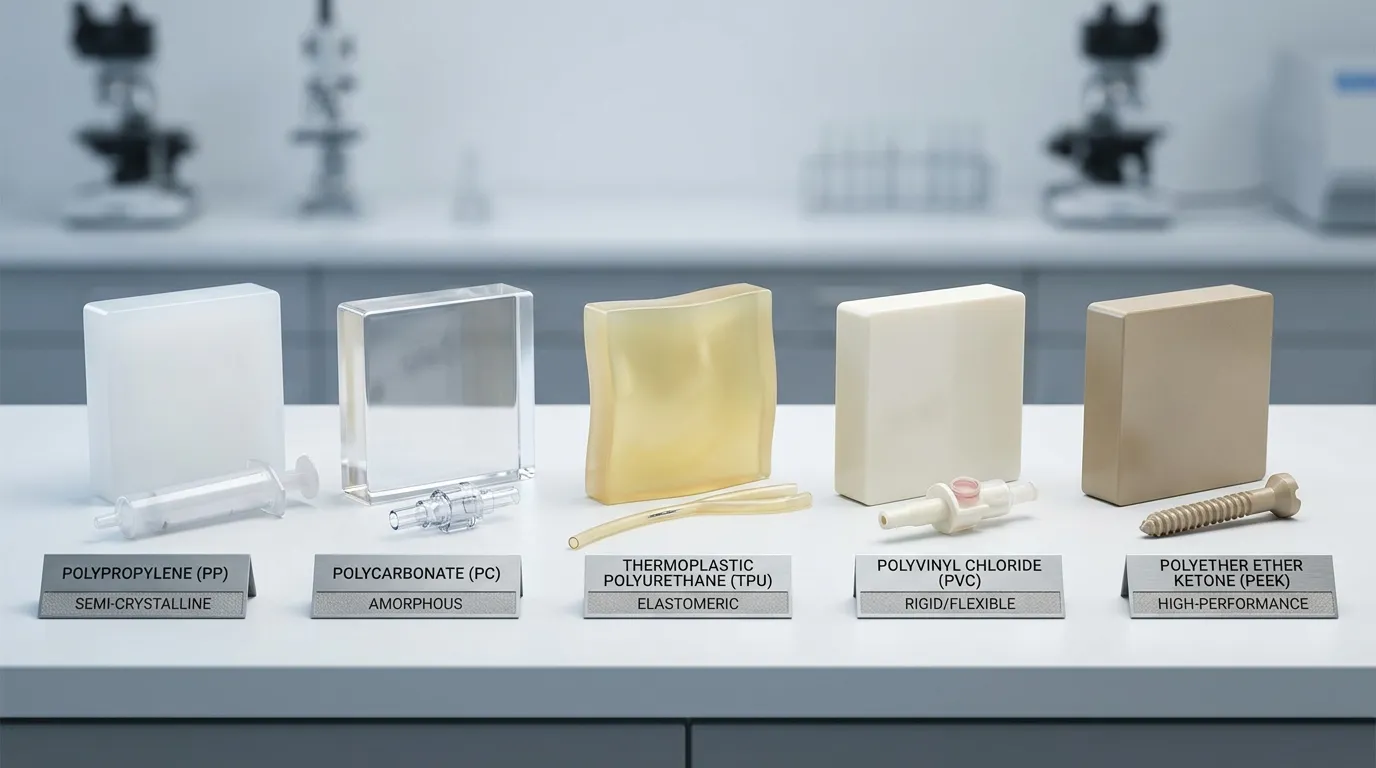
Polypropylene, polycarbonate, PEEK, TPU, and PVC are among the most common medical injection molding materials. The right choice depends on sterilization method, chemical resistance, flexibility, strength, transparency, and whether the part contacts the patient directly.
Material selection affects cost, durability, sterilization compatibility, and production speed. Medical-grade plastics are tested for manufacturing consistency and application suitability, especially in patient-contact environments.
A disposable syringe housing may prioritize low cost and gamma sterilization compatibility. A reusable surgical component may need higher heat resistance and dimensional stability. Choosing the wrong material can increase rejection rates or create sterilization problems later.
When to use polypropylene in medical devices
Polypropylene (PP) is one of the most common medical molding materials because it balances cost, chemical resistance, and production efficiency. It works well for disposable products such as syringes, specimen containers, and packaging components.
PP is not always the strongest option, but it performs well in high-volume production. For disposable devices, it often makes more sense than expensive engineering plastics.
When high-performance plastics like PEEK make sense
PEEK is used in demanding applications that require heat resistance, mechanical strength, or repeated sterilization cycles. It is common in advanced medical components and specialized surgical systems.
PEEK is not automatically the best choice. The material cost is much higher than polypropylene or polycarbonate. If the application does not require high-temperature performance or structural strength, a simpler resin may be more practical.
| Material | Sterilization Compatibility | Transparency | Flexibility | Chemical Resistance | Typical Use |
|---|---|---|---|---|---|
| Polypropylene (PP) | Good | Low | Medium | Good | Syringes, containers |
| Polycarbonate (PC) | Good | High | Low | Medium | Diagnostic housings |
| TPU | Moderate | Medium | High | Good | Catheter components |
| PVC | Good | Medium | Medium | Good | IV tubing |
| PEEK | Excellent | Low | Low | Excellent | Surgical components |
Some suppliers also evaluate resin selection based on mold wear, cycle time, and long-term tooling maintenance. Sunshine Pro’s medical mold materials guide explains how tooling considerations can affect material performance.
What standards and regulations apply to medical molding?
Medical molding suppliers often work within ISO 13485 quality systems and follow FDA manufacturing expectations for process control, traceability, documentation, and validation. Exact requirements depend on the medical device classification and target market.
Medical molding projects usually involve stricter documentation and process control than standard manufacturing. Suppliers may maintain validated production records, inspection reports, and material traceability throughout the project lifecycle.
The FDA expects manufacturers to control production processes that affect medical device quality. Many suppliers also follow ISO 13485 quality-management systems to support consistency and traceability.
Basic Medical Molding Compliance Checklist
- Material lot traceability
- Documented inspection records
- Controlled process settings
- Validation procedures
- Packaging and contamination controls
- Change-management documentation
Why traceability matters in medical manufacturing
Traceability allows manufacturers to track which material batch and production lot produced each component. If a defect appears later, teams can isolate the affected production run more quickly.
This becomes important during recalls, audits, or customer complaints. Without traceability, manufacturers may need to quarantine much larger production volumes.
Do medical parts always require cleanroom molding?
Not every medical plastic part requires cleanroom molding. Cleanrooms are usually necessary when contamination control directly affects sterility, patient safety, packaging integrity, or regulatory requirements for the finished device.
Cleanrooms help reduce airborne particles, contamination, and environmental variation during production. They are common for sterile devices, implant-support components, and sensitive packaging applications.
Some buyers assume every medical component needs cleanroom production. That is not always true. Using a cleanroom without a contamination-driven requirement can increase manufacturing cost without adding practical value.
| If the Product Requires... | Cleanroom Need |
|---|---|
| Sterile packaging | Usually required |
| Patient-contact surfaces | Often required |
| Disposable non-sterile parts | Sometimes unnecessary |
| Sensitive diagnostic assemblies | Often recommended |
| Cosmetic-only plastic housings | Depends on risk level |
Common cleanroom classifications for medical molding
Many suppliers use ISO cleanroom classifications to define environmental control levels. The required class depends on contamination sensitivity, assembly requirements, and customer specifications.
For example, catheter-related components packaged for sterile environments often need tighter contamination control than a non-sterile diagnostic equipment housing.
What quality checks matter most in medical injection molding?
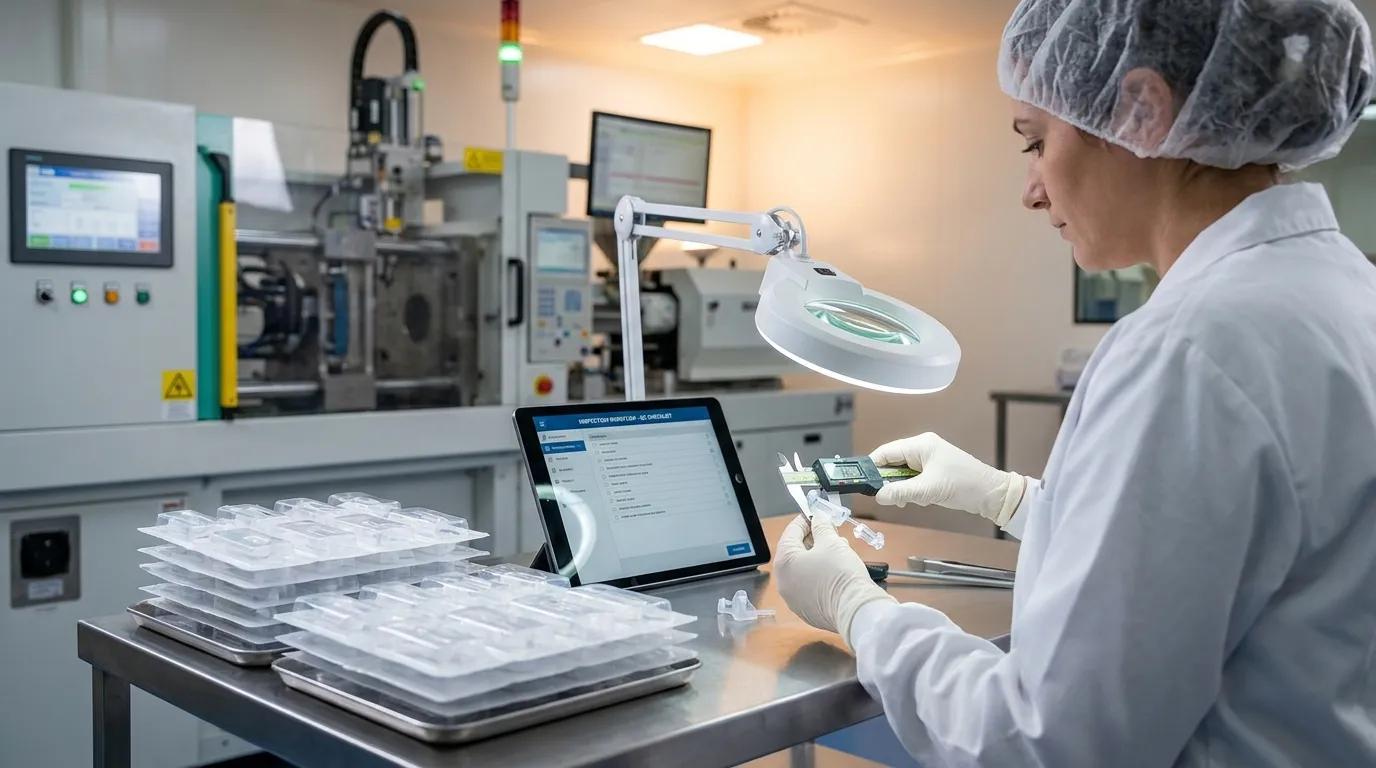
Medical injection molding quality control focuses on dimensional accuracy, contamination prevention, material traceability, process consistency, and documented inspection results. QC systems are designed to reduce patient risk and maintain repeatable production performance.
Medical molding quality checks begin before production starts. Teams often inspect incoming resin batches, verify material certifications, and confirm traceability records before molding begins.
During production, inspectors monitor dimensions, cosmetic quality, flash, sink marks, contamination, and assembly fit. First article inspection is common during setup approval and process validation stages.
Medical Injection Molding QC Checklist
| QC Step | Purpose |
|---|---|
| Incoming resin verification | Confirm material matches specification |
| Lot traceability review | Track production batches |
| First article inspection | Validate startup dimensions |
| Dimensional inspection | Verify tolerances |
| Surface inspection | Detect flash or contamination |
| Packaging inspection | Prevent handling damage |
| Documentation review | Confirm process records |
Common molding defects that trigger rejection
Flash, short shots, contamination, burn marks, and dimensional variation are common rejection causes. A small defect can create sealing problems or assembly failures in medical products.
A catheter-related component is a good example. Even minor contamination inside the molded part can affect packaging integrity or downstream sterilization performance. That is why contamination-sensitive products often require tighter process controls.
Suppliers should also maintain documented inspection workflows. Sunshine Pro’s mold inspection points guide explains how tooling condition and cavity performance affect part quality over time.
How are medical molds validated before production?
Medical mold validation confirms that tooling and processing conditions consistently produce compliant parts. Manufacturers commonly document installation qualification, operational qualification, and performance qualification before full production approval.
Validation helps confirm that the mold, machine settings, and production workflow can repeatedly produce acceptable parts. This process reduces variation before high-volume manufacturing begins.
The FDA recommends process validation for manufacturing operations that affect product quality. In medical molding, validation usually follows a staged approval process.
Typical Medical Mold Validation Workflow
- Installation Qualification (IQ)
Teams verify that tooling, machines, and support systems are installed correctly. - Operational Qualification (OQ)
Engineers test process settings such as pressure, cooling time, and temperature ranges. - Performance Qualification (PQ)
Production runs confirm the process can consistently produce acceptable parts at normal operating conditions.
A tooling project can easily slow down if validation planning starts too late. One common issue is approving steel cutting before finalizing part geometry. If the customer changes dimensions after tooling begins, lead times can increase significantly.
Suppliers also need clear documentation during production transfers and shipping. Customs delays can affect launch schedules when paperwork or product classifications are incomplete.
For broader process guidance, Sunshine Pro’s mold validation workflow resource explains how tooling and process planning fit together.
How should buyers evaluate a medical injection molding supplier?
Choosing a medical molding supplier involves more than checking machine capacity. Buyers should review validation capability, traceability systems, documentation practices, and contamination-control procedures before approving production.
ISO certification alone does not guarantee good medical molding performance. A supplier may hold certifications but still lack strong process validation or inspection discipline.
Medical Supplier Evaluation Checklist
- ISO 13485 quality-management systems
- Validation workflow capability
- Cleanroom availability if required
- Material traceability procedures
- First article inspection process
- Documented change-management controls
- Production lead-time planning
- Packaging and shipping controls
Lead time management also matters. A shipment held at customs because of incomplete documentation can delay device launches and customer approvals. Suppliers should understand export paperwork, product classification, and medical-device shipping requirements before production begins.
Sunshine Pro’s guide to tooling and production planning explains how early planning decisions affect lead time, tooling revisions, and long-term manufacturing consistency.
Getting the Next Step Right
Medical injection molding works best when material selection, validation planning, and quality control are aligned early in the project. Buyers who define inspection standards, contamination requirements, and traceability expectations before tooling begins usually avoid costly production delays later.
If you are evaluating suppliers, focus on process discipline instead of marketing claims alone. Ask how the supplier handles validation, inspection records, material tracking, and corrective actions. A strong medical molding partner should explain those systems clearly and support practical production decisions from sampling through full-scale manufacturing.
Frequently Asked Questions
Medical-grade plastic is a polymer tested for consistency and suitability in healthcare applications. The exact requirements depend on whether the material contacts patients, drugs, or sterile environments.
Polypropylene, polycarbonate, TPU, PVC, and PEEK are common medical molding materials. The best option depends on sterilization needs, flexibility, chemical resistance, and mechanical performance.
No, not every medical component requires cleanroom molding. Cleanrooms are mainly used when contamination control affects sterility, patient safety, or sensitive packaging requirements.
Many medical molding suppliers follow ISO 13485 quality systems and FDA manufacturing expectations. The exact requirements depend on device classification and target market regulations.
Flash, short shots, sink marks, contamination, and dimensional variation are common molding defects. These problems can affect assembly fit, sterility, or device performance.
Production timelines vary based on tooling complexity, validation requirements, and sampling approvals. Tooling and validation can take weeks or several months depending on project scope.
Tooling revisions, failed validation runs, customs delays, and incomplete documentation commonly slow medical molding projects. Design changes after tooling approval can also extend production timelines significantly.
Share:



Written By Sunshine
At Sunshine, we are a professional manufacturer and supplier of precision mould components, offering a wide range of products for stamping and injection mould applications. Our core focus includes punching dies, ejector pins and sleeves, and guide posts and bushings. With advanced CNC machining, strict quality control, and strong production capabilities, we ensure reliable, high-precision parts, along with in-stock standard components for fast and efficient global supply.
NEWS
GET SERVICE
With quality parts to meet every budget and friendly staff trained to make your visit informative and hassle free.
