



Punch Pins for Stainless Steel Stamping: Material and Coating Options
There is no single best material or coating for punch pins used in stainless steel stamping. The right combination depends on the stainless grade and condition, sheet thickness, punch geometry, production volume, lubrication, die alignment, clearance, and the failure mode already appearing in production.
A punch substrate provides the bulk toughness, compressive strength, and edge support. Heat treatment establishes its usable hardness and fracture resistance. Surface finish affects friction and material pickup. The coating or surface treatment then modifies wear, heat, and sliding behavior. Choosing only one of these elements rarely solves the complete problem.
This guide focuses on punch pins used to pierce or blank stainless steel sheet. It does not assume that the punch itself must be made from stainless steel. For broader information about die types, system-level material selection, clearance, tolerances, and sourcing, see the punching dies guide (inferred).
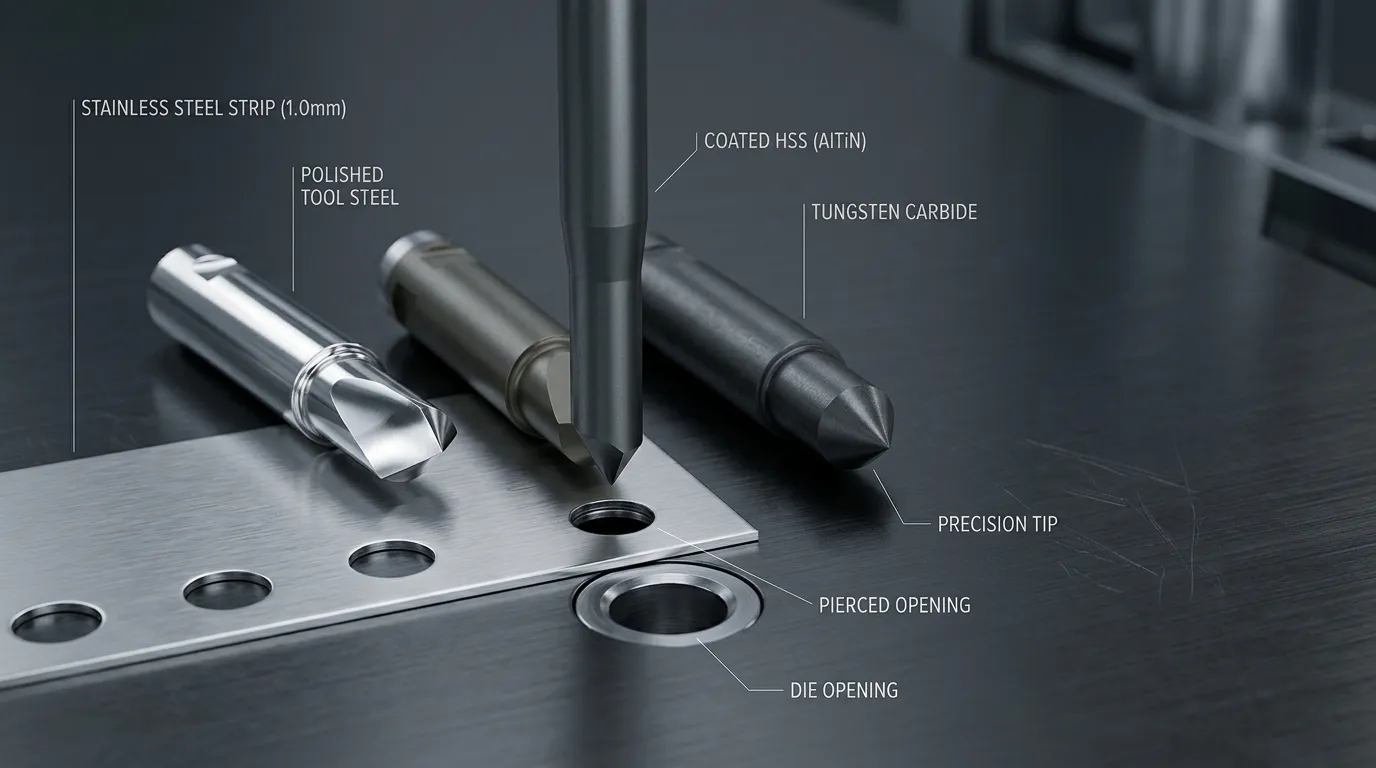
Why Stainless Steel Changes Punch-Pin Selection
Stainless steel is not one uniform work material. Austenitic, ferritic, martensitic, and duplex grades have different mechanical properties and forming behavior. The worldstainless overview of stainless steel families is useful background, but the tooling decision must go further than identifying the family name.
The supplier or tool engineer should know:
- the exact stainless grade;
- sheet thickness;
- temper, hardness, or tensile condition;
- surface condition;
- pierced-hole or blank geometry;
- expected production quantity;
- lubrication method or restrictions;
- current punch material and coating;
- the actual failure seen in production.
Stainless applications often create high contact pressure, sliding friction, and heat at the punch surface. Under unfavorable conditions, workpiece material can transfer onto the punch. This adhesive wear process is commonly described as galling or material pickup.
A peer-reviewed review of galling in metal forming explains that friction, surface condition, pressure, temperature, and wear development interact during the process. Once pickup begins, the roughened punch surface can attract more material, increase stripping force, damage the sheet surface, and accelerate further wear.
Stainless sheet may also work-harden near the cutting zone. Thicker or stronger material raises the load on the cutting edge. These conditions make it risky to choose a punch only by nominal hardness.
Choose the Punch Substrate Before Choosing the Coating
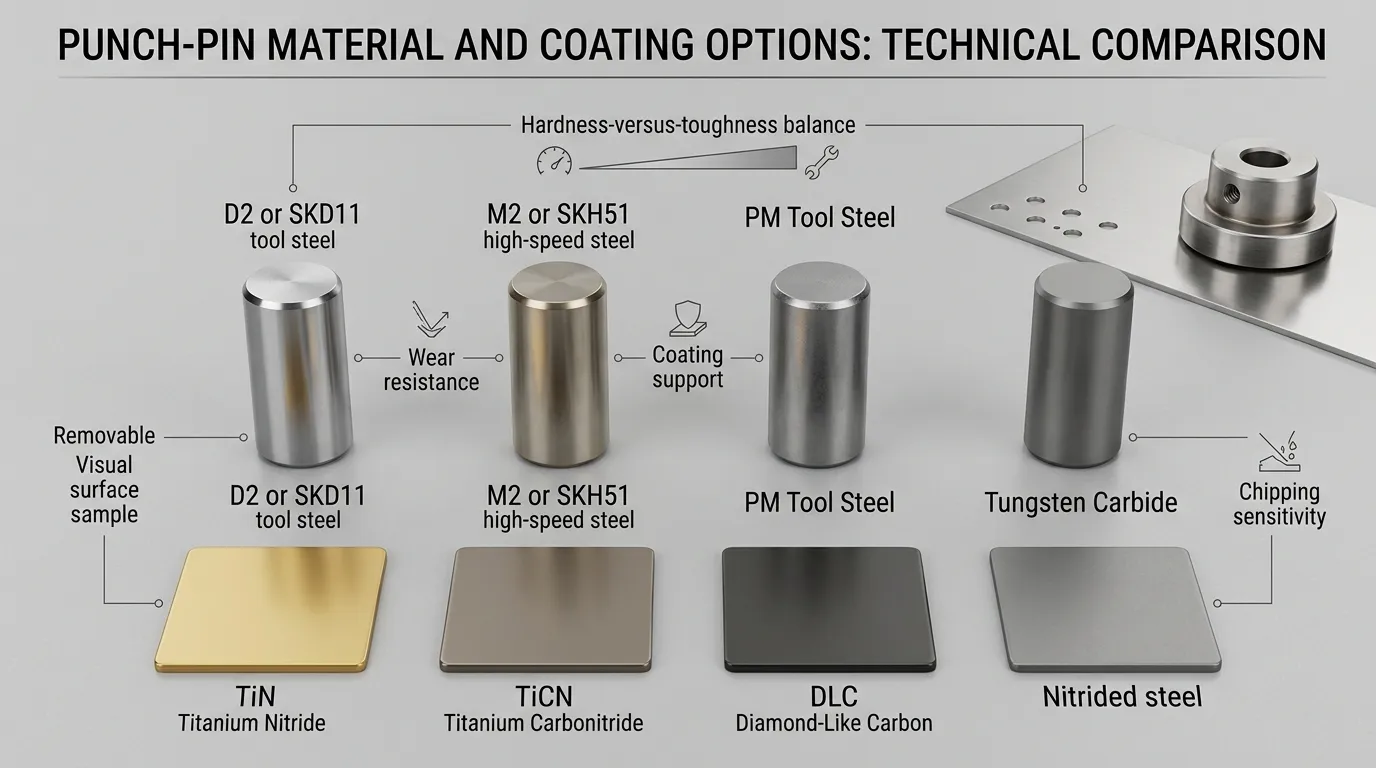
The coating is supported by the material underneath it. A hard coating on an unsuitable, poorly heat-treated, or damaged substrate can still crack, delaminate, chip, or fail with the cutting edge.
The main punch-material options should be compared using several properties:
| Punch substrate | Main strengths | Main limitations | Typical reason to consider it |
|---|---|---|---|
| D2 or SKD11-type tool steel | Wear resistance, compressive strength, dimensional stability | Can be less tolerant of impact, deflection, or sharp stress concentrations than tougher grades | Stable geometry and moderate wear-led production |
| M2, SKH51, or SKH9 HSS | Better balance of wear resistance, toughness, and heat resistance | Higher cost than conventional tool steel; still dependent on correct heat treatment | Stainless, thicker sheet, coated punches, or higher production demands |
| PM tool steel | Strong wear–toughness balance and more uniform microstructure | Premium material cost and grade-specific processing requirements | When conventional steel wears too quickly but carbide is too brittle |
| Shock-resistant tool steel | High toughness and resistance to impact-related fracture | Lower wear resistance than strongly alloyed wear grades | Chipping or impact is more important than gradual wear |
| Tungsten carbide | Very high hardness, compressive strength, and wear resistance | Brittle under misalignment, shock, deflection, or poor edge support | Stable high-wear production with rigid tooling |
| Stainless tool steel such as SUS420 or SUS440 | Corrosion resistance and polishability | Not automatically the best substrate for piercing stainless sheet | Corrosive environments or applications where the punch itself needs corrosion resistance |
D2 or SKD11 for Stable, Wear-Led Applications
D2-class cold-work tool steel is widely used where wear resistance and compressive strength are important. Material documentation for BÖHLER K110, a D2-class steel, lists stamping and blanking among its applications and emphasizes wear resistance and dimensional stability.
D2 or SKD11 may be a reasonable starting point when:
- the punch has a robust cross-section;
- alignment and clearance are controlled;
- production volume is moderate;
- gradual wear is the main concern;
- sudden chipping or bending is not occurring.
It becomes a weaker choice when the punch is very slender, has sharp corners, experiences side loading, or breaks before the cutting edge wears out. In those cases, additional hardness may make the problem worse rather than better.
M2, SKH51, or SKH9 When Toughness and Heat Resistance Matter More
High-speed steel is commonly evaluated when the punch needs a stronger balance of wear resistance, toughness, and resistance to heat generated during repeated cycling.
Technical guidance from CONIC on tooling materials associates M2-type material with stainless steel, thicker sheet, coating use, and larger production quantities. That does not make M2 a universal answer, but it explains why HSS often appears in stainless stamping recommendations.
SunshinePro’s high-speed steel punch page lists SKH51 and SKH9 among its material options, along with vacuum heat treatment, precision grinding, EDM, and optional TiN or TiCN coatings. These are company-specific product options, not fixed specifications for every application.
HSS is worth evaluating when:
- D2 wears or chips too quickly;
- surface heat is significant;
- the punch will receive a PVD coating;
- production volume justifies a higher-cost substrate;
- the geometry needs more fracture resistance than conventional wear steel provides.
PM Tool Steel for a Higher Wear–Toughness Balance
Powder-metallurgy tool steels are useful when both wear and fracture resistance matter. Their more uniform microstructure can provide a better combination of properties than many conventionally produced tool steels.
For example, the manufacturer describes BÖHLER K490 MICROCLEAN as a PM cold-work steel combining wear resistance, compressive strength, toughness, and dimensional stability for applications that include stamping and blanking.
PM steel may be justified when:
- conventional D2-type steel wears too quickly;
- HSS does not provide the required service interval;
- carbide chips under the existing geometry or loading;
- downtime costs more than the material upgrade;
- repeated regrinding and stable dimensional behavior are important.
The recommendation must still be grade-specific. “PM steel” is a manufacturing category, not one standardized set of properties.
Carbide for Stable High-Wear Conditions, Not Every High-Volume Job
Tungsten carbide offers high hardness, compressive strength, and resistance to abrasive wear. It can be effective in stable, high-volume applications where the punch receives rigid support and loading remains predictable.
Its main limitation is brittleness. Carbide is less forgiving of:
- misalignment;
- punch deflection;
- impact or interrupted loading;
- weak corner geometry;
- inadequate support;
- slug interference;
- side loading;
- incorrect clearance.
A carbide punch that chips after a few cycles is not improved by selecting an even harder carbide grade without correcting the mechanical cause.
SunshinePro’s carbide punch page lists tungsten carbide, precision grinding, EDM, customized dimensions, and TiN, TiCN, or DLC coating options. Suitability still requires a review of the punch geometry, workpiece, press conditions, and failure history.
When a Stainless Tool-Steel Punch Is Actually the Requirement
A punch used on stainless steel does not automatically need a stainless substrate.
Corrosion-resistant grades such as SUS420 or SUS440 may be selected when the tool itself is exposed to moisture, corrosive substances, frequent cleaning, or an environment where rust resistance matters. SunshinePro lists these grades on its separate stainless punch-pin product page.
That is a different engineering requirement from selecting a wear-resistant punch for stainless sheet. In many stamping applications, HSS, PM steel, conventional tool steel, or carbide may provide a more useful balance of wear, toughness, and edge stability.
Match the Coating or Surface Treatment to the Failure Mode
Coating choice should begin with the observed surface failure.
- Adhesive wear or galling: prioritize low friction, resistance to material transfer, surface preparation, and lubrication.
- Abrasive wear: prioritize surface hardness and resistance to gradual material loss.
- High heat: review thermal stability and compatibility with the substrate’s heat-treatment condition.
- Chipping or fracture: correct the substrate, geometry, alignment, or loading before focusing on the coating.
- High stripping force: inspect pickup, finish, lubrication, and punch withdrawal conditions.
A coating name alone is not enough. Performance also depends on coating thickness, adhesion, deposition process, edge preparation, substrate hardness, operating temperature, and surface finish.
TiN and TiCN Are Common Options, Not Universal Answers
TiN is one of the most familiar hard coatings used on tooling. It can improve wear resistance in suitable systems, but it should not automatically be described as the preferred stainless-steel coating.
For example, Dayton Lamina’s coating guidance assigns different treatments to adhesive wear, abrasive wear, heat, and specific work materials. Its recommendations also show that TiN is not universally preferred for stainless applications.
TiCN is commonly considered where higher wear resistance and improved sliding behavior are required. It may be evaluated for abrasive wear or material-pickup problems, but its performance still depends on substrate support, surface preparation, coating quality, and operating conditions.
SunshinePro lists TiN and TiCN as available options on its HSS and stainless-steel punch-pin pages. The final selection should be based on the actual application rather than coating popularity.
AlTiN or AlCrN for Heat-Related Conditions
AlTiN and AlCrN coatings are often considered where elevated surface temperature and demanding wear conditions are central concerns.
Before selecting either coating, confirm:
- the substrate’s tempering resistance;
- coating-process temperature;
- required friction behavior;
- edge preparation;
- coating adhesion;
- whether heat or galling is the dominant failure.
A heat-resistant coating will not correct an unsupported edge or a punch that bends under load.
DLC and Lubricious Multilayer Systems for Adhesive Wear
DLC and other low-friction multilayer systems may be considered where adhesive wear, galling, and high stripping force dominate.
Technical guidance from tooling manufacturers such as Mate Precision connects low-friction coating selection with lubrication restrictions, punch dimensions, sheet thickness, and deflection. This is important because a lubricious surface can reduce friction, but it cannot stabilize a weak punch geometry.
DLC suitability depends on the substrate, deposition process, service temperature, coating adhesion, and edge loading. SunshinePro lists DLC on its carbide-punch page, but that does not confirm availability or suitability for every punch material.
Nitriding When a Diffusion Treatment Fits the Service Plan
Nitriding hardens the punch surface by diffusion rather than adding a separate deposited layer. It can be useful where surface hardness and geometry coverage are important.
Its selection should consider:
- substrate compatibility;
- case depth;
- required surface finish;
- dimensional change;
- regrinding allowance;
- whether the treated layer will remain after sharpening.
Nitriding should not be described as a SunshinePro capability unless confirmed for the specific order. It remains a general technical option to discuss with the tooling and treatment supplier.
Diagnose the Failure Before Upgrading the Tool
A more expensive material or coating is useful only when it addresses the actual failure.
| Observed symptom | Likely mechanism | Check before upgrading | Possible material direction | Possible surface direction |
| Stainless buildup on the punch | Galling or adhesive wear | Finish, lubrication, heat, clearance, stripping action | Retain a tough substrate if it is not deforming or chipping | Low-friction PVD, DLC-type system, nitriding, or improved polishing depending on conditions |
| Gradual edge rounding | Abrasive wear | Workpiece condition, clearance, punch hardness, production volume | HSS, PM steel, or carbide if the process is stable | TiCN or another wear-focused coating |
| Small chips at the cutting edge | Local fracture or insufficient toughness | Edge geometry, alignment, corners, punch support, heat treatment | Tougher HSS, PM steel, or shock-resistant steel | Do not treat coating as the main fix |
| Sudden punch breakage | Mechanical overload, deflection, misalignment, or brittle substrate | Guidance, retainer, clearance, slug interference, punch length | Toughness-led substrate after correcting the mechanical cause | Coating is secondary |
| Edge deformation or rollover | Inadequate hardness, compressive strength, or support | Heat treatment, punch load, thickness, geometry | Higher-strength tool steel, HSS, PM steel, or carbide where stable | Wear coating only after substrate correction |
| High withdrawal force | Pickup, poor stripping, rough finish, or inadequate lubrication | Stripper condition, punch surface, lubricant, side loading | Maintain sufficient toughness for withdrawal load | Low-friction treatment where compatible |
General fracture diagnosis belongs in the separate guide to punch breakage in stamping dies. The critical point here is that chipping and breakage often indicate a bulk-material or mechanical problem, not a missing coating.
Check Geometry and Die Conditions Before Blaming the Material
The punch operates as part of a complete die system. Before changing the substrate or coating, inspect the conditions that control how the load reaches the cutting edge.
- Confirm punch alignment. Misalignment creates uneven edge loading and can chip even a premium punch.
- Review punch-and-die clearance. Clearance should match the workpiece material and thickness. An unsuitable value can increase force, burr formation, wear, and fracture risk.
- Inspect the stripper and guide system. Poor guidance or abnormal stripping can bend the punch during withdrawal.
- Check the retainer and mounting condition. Movement at the head or shank changes how the punch is loaded.
- Inspect for slug interference. A trapped or pulled slug can create sudden overload.
- Review the punch surface. Grinding marks, damage, or pickup can accelerate galling.
- Confirm lubrication. Restricted lubrication changes the friction and coating requirements.
- Account for coating thickness. Final dimensions and tolerances should reflect the complete coated condition.
The die components guide provides broader information about punches, pins, bushings, guide components, and wear parts.
Small and Slender Punches Need a Toughness-First Review
A small-diameter or high-aspect-ratio punch can deflect before the cutting edge reaches its nominal material limit.
Risk rises when the punch has:
- excessive unsupported length;
- sharp corners;
- narrow sections;
- side loading;
- interrupted contact;
- poor guidance;
- heavy stripping force.
In this situation, selecting carbide or maximizing hardness can increase chipping risk. A tougher HSS or PM steel, shorter unsupported length, stronger guidance, and improved corner design may provide a better result than a harder coating.
Use Application Conditions to Shortlist the Material–Coating System
The following matrix provides a starting direction, not a final engineering specification.
| Application condition | Substrate direction to evaluate | Surface direction to evaluate | Verify first |
| Moderate volume, robust geometry, controlled process | D2/SKD11 or HSS | Polished uncoated surface, TiN, TiCN, or nitriding depending on wear | Grade, thickness, clearance, lubrication |
| High-volume abrasive wear | HSS, PM steel, or carbide | Wear-focused PVD treatment | Alignment, edge support, regrinding plan |
| Galling with visible material pickup | Tough HSS or PM steel if the substrate remains stable | Low-friction PVD, DLC-type system, multilayer coating, or nitriding | Finish, lubricant, heat, stripper action |
| Small or slender punch with chipping | Tough HSS, PM steel, or shock-resistant steel | Coating only after fracture cause is controlled | Unsupported length, guidance, corners, alignment |
| Thick or high-load stainless sheet | HSS or PM steel; carbide only in a rigid, stable setup | Heat- and wear-appropriate coating | Punch load, clearance, support, press condition |
| Corrosive tool environment | Corrosion-resistant stainless tool steel where load permits | Treatment compatible with the selected stainless substrate | Whether corrosion resistance or punching performance is the main priority |
Do not use this matrix to skip testing or drawing review. Two applications using the same stainless grade may need different punches because the thickness, hole diameter, punch length, lubrication, press speed, and service expectations are different.
Compare Tooling Options by Serviceability and Cost per Hit
Initial purchase price is a weak basis for comparing punch options.
A more useful evaluation includes:
- hits between sharpening or replacement;
- unplanned downtime;
- tool-change frequency;
- regrinding cost;
- recoating feasibility;
- dimensional loss after sharpening;
- scrap and surface-damage risk;
- inspection time;
- replacement lead time;
- probability of sudden fracture.
A PM steel or carbide punch may cost more at the start but reduce cost per hit in a stable application. The same upgrade can become expensive if the punch continues to break because of misalignment or poor guidance.
Regrinding also changes the tool. It can reduce punch length, remove the treated surface near the cutting edge, alter corner geometry, and affect shut height or penetration. Recoating is possible only when enough usable material remains and the surface can be restored to the condition required by the coating supplier.
The service plan should therefore be considered before the original material and coating are selected.
Information to Include in a Custom Punch-Pin RFQ
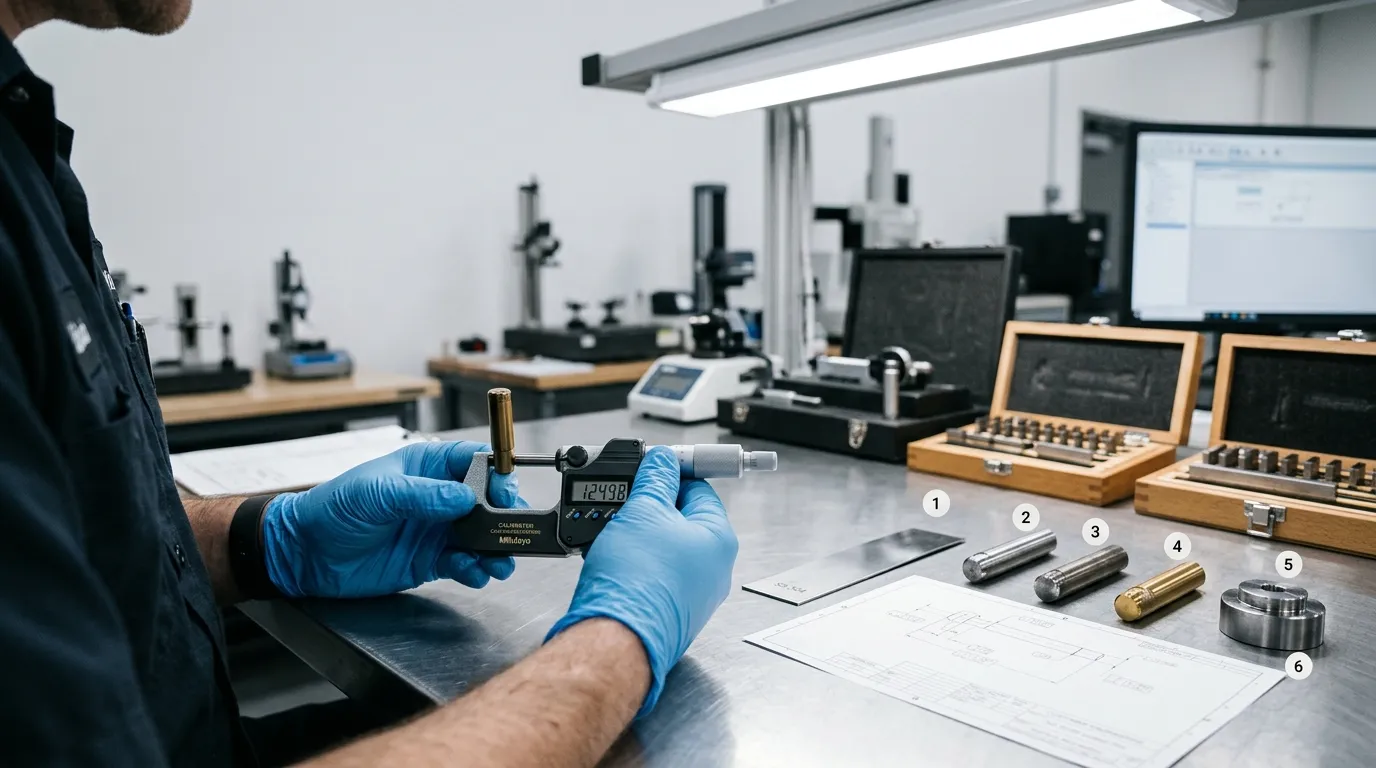
A supplier cannot make a defensible recommendation from the phrase “punch for stainless steel” alone.
Include the following information in the request:
- stainless grade and family;
- sheet thickness;
- temper, hardness, or tensile condition;
- part and hole drawing;
- punch diameter, length, head, shank, and corner geometry;
- required dimensional tolerances;
- die clearance where known;
- press type and stroke rate;
- expected production volume;
- target service interval;
- lubricant or dry-running restriction;
- current punch material and hardness;
- current coating or treatment;
- photographs or samples of wear, pickup, chipping, or breakage;
- regrinding and recoating expectations;
- required material, hardness, dimensional, or coating documentation.
SunshinePro states that it supplies standard components and non-standard customized parts processed from customer drawings. Its relevant punch pages list combinations of CNC machining, precision grinding, EDM, vacuum heat treatment, custom dimensions, HSS, carbide, stainless tool steel, and selected coating options.
These website-confirmed capabilities should still be reviewed against the actual drawing and application. A tolerance or material listed on one product page should not be assumed to apply to every punch geometry.
Final Selection Principle
Use this order when selecting punch pins for stainless steel stamping:
- Identify the stainless grade, condition, thickness, and feature geometry.
- Determine whether the current failure is galling, abrasive wear, chipping, breakage, or deformation.
- Correct alignment, clearance, guidance, finish, stripping, and lubrication problems.
- Select the substrate for bulk toughness, compressive strength, and edge stability.
- Select the coating or treatment for the dominant surface failure.
- Compare serviceability, downtime, and cost per hit.
- Confirm the final system through drawing review and application-specific validation.
For a custom review, submit the drawing, stainless specification, production conditions, and current failure details through SunshinePro’s contact page. That information gives the supplier a practical basis for evaluating the punch material, heat treatment, finish, coating, and inspection requirements.
Share:



Written By Sunshine
At Sunshine, we are a professional manufacturer and supplier of precision mould components, offering a wide range of products for stamping and injection mould applications. Our core focus includes punching dies, ejector pins and sleeves, and guide posts and bushings. With advanced CNC machining, strict quality control, and strong production capabilities, we ensure reliable, high-precision parts, along with in-stock standard components for fast and efficient global supply.
NEWS
GET SERVICE
With quality parts to meet every budget and friendly staff trained to make your visit informative and hassle free.
