



Custom Plastic Injection Molding: Tooling, Materials, and Production Guide
Custom plastic injection molding works best for products that need repeatable quality, scalable production, and tight dimensional control. Success depends on choosing the right tooling, resin, and validation process before mass production begins. Buyers should evaluate mold type, sampling procedures, production lead times, and supplier experience early to reduce revision costs, delays, and long-term quality issues.
Custom molded parts can fail long before production starts if tooling, materials, or DFM decisions are rushed. A strong injection molding project is built around planning, not just machine capacity. Buyers need clear answers about tooling cost, resin selection, production timing, and validation steps before approving steel cutting or mass production.
What is custom plastic injection molding and when does it make sense?
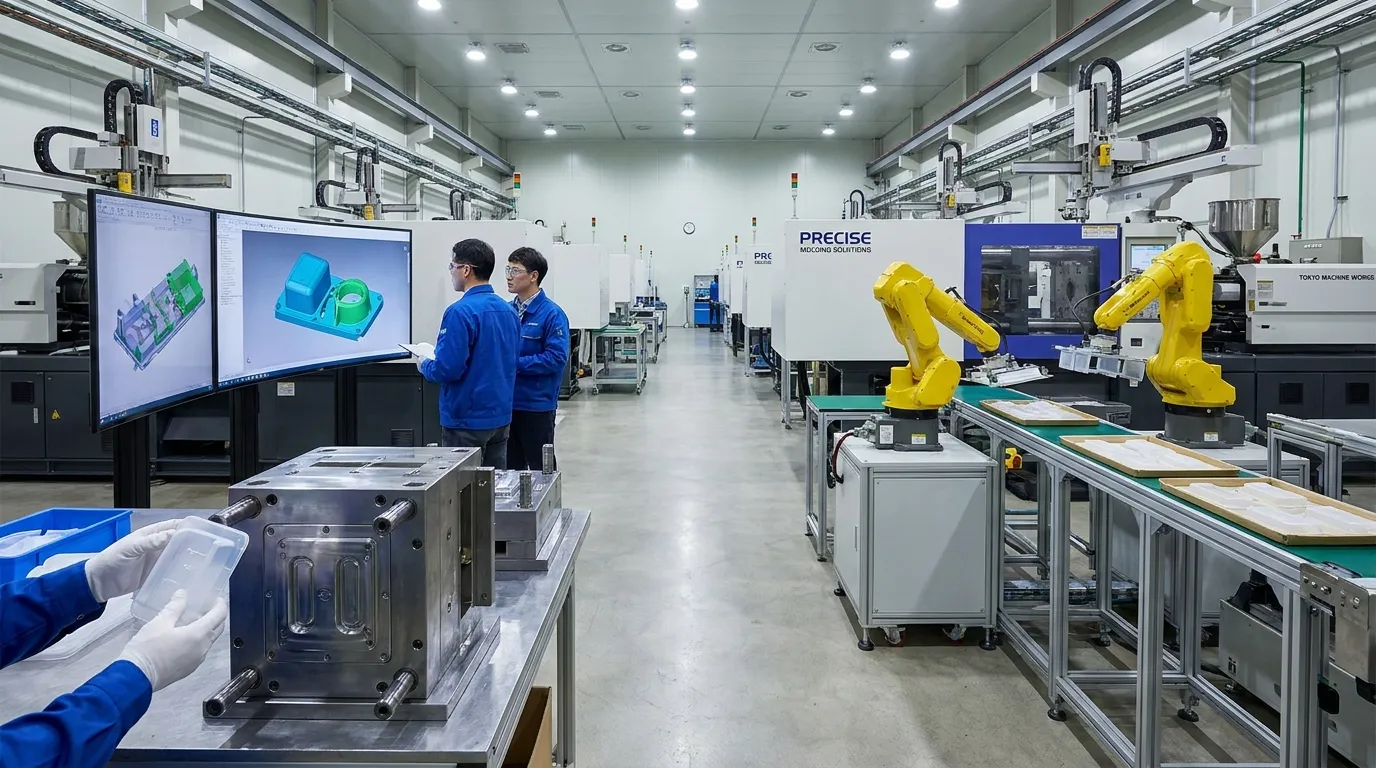
Custom plastic injection molding works best when a product needs repeatable quality, tight tolerances, and medium-to-high production volume. The process requires upfront tooling investment, but lowers per-part cost once production scales.
Injection molding creates plastic parts by injecting molten resin into a mold cavity under pressure. The same mold can produce thousands or millions of identical parts with consistent dimensions and surface finish.
The process makes sense when a product requires stable repeatability, cosmetic consistency, or complex geometry. Consumer electronics housings, automotive clips, appliance components, and medical enclosures are common examples. According to IQS Directory, injection molding remains one of the most widely used methods for large-scale plastic part production.
| Manufacturing Need | Injection Molding Fit |
|---|---|
| High production volume | Excellent |
| Tight tolerances | Strong |
| Fast prototype changes | Limited after tooling |
| Low upfront investment | Poor |
| Cosmetic surface finish | Strong |
| Repeatable output | Excellent |
Low-volume projects sometimes benefit from bridge tooling or aluminum molds. A startup producing 5,000 consumer electronics housings may use aluminum tooling first to reduce launch risk before moving to hardened steel tooling later.
For a broader overview of mold structures and tooling systems, see the injection mold guide.
How does the custom injection molding process work from design to production?
Most custom injection molding projects follow a predictable sequence: DFM review, tooling fabrication, T1 sampling, revisions, validation, and mass production. Problems become far more expensive once steel cutting begins.
A typical project starts with a DFM review, short for Design for Manufacturability. Engineers evaluate wall thickness, draft angles, gating positions, material flow, and part geometry before tooling begins. Early DFM approval prevents expensive mold revisions later.
Once the design is approved, the manufacturer creates the mold tool. This stage includes CNC machining, EDM work, polishing, fitting, and cooling channel preparation. The full mold production workflow usually takes several weeks depending on mold complexity.
DFM review
DFM is where many projects either stay on track or begin slipping. A buyer changing wall thickness after steel cutting may trigger additional machining, delayed sampling, and new validation rounds.
One common example is an automotive supplier switching from ABS to PC/ABS after tooling starts because the original resin failed heat testing. That single material change can affect shrinkage rates, gating, and cooling behavior.
T1 and validation
After tooling is complete, the manufacturer runs the first trial shot, often called T1 sampling. Engineers inspect dimensions, cosmetic finish, gate marks, flash, and cycle consistency.
Mass production should not begin immediately after T1 approval. Stable production requires process tuning, repeatability checks, and validated inspection procedures before the production ramp starts.
How do you choose the right plastic material?
Material selection affects strength, heat resistance, tooling wear, cycle time, and final part cost. Choosing resin based only on price often creates long-term production problems.
The right resin depends on the product’s environment, load requirements, appearance goals, and production conditions. Polypropylene works well for flexible consumer parts, while polycarbonate provides stronger heat resistance and impact performance.
A resin also affects tooling life and production efficiency. Glass-filled materials can increase mold wear. High-temperature resins often require slower cycle times and more advanced tooling design. Goodfish Group explains how resin behavior directly impacts manufacturability and long-term part performance.
| Material | Best Use | Key Benefit | Limitation |
|---|---|---|---|
| PP | Consumer goods | Low cost, flexible | Lower heat resistance |
| ABS | Housings | Good appearance | Moderate durability |
| PC | Electronics | High impact strength | Higher cost |
| Nylon | Mechanical parts | Wear resistance | Moisture absorption |
The cheapest resin is not always the lowest total cost. A lower-grade material may increase defect rates, cosmetic rejection, or part failure during production.
A medical device project may require multiple resin evaluations before approval. If sterilization temperatures exceed the material’s limit, the part can warp or crack after shipment. In those cases, engineering-grade resin becomes necessary even if tooling and cycle costs increase.
For broader mold and resin production context, see plastic mold solutions.
Should you use aluminum or steel tooling?
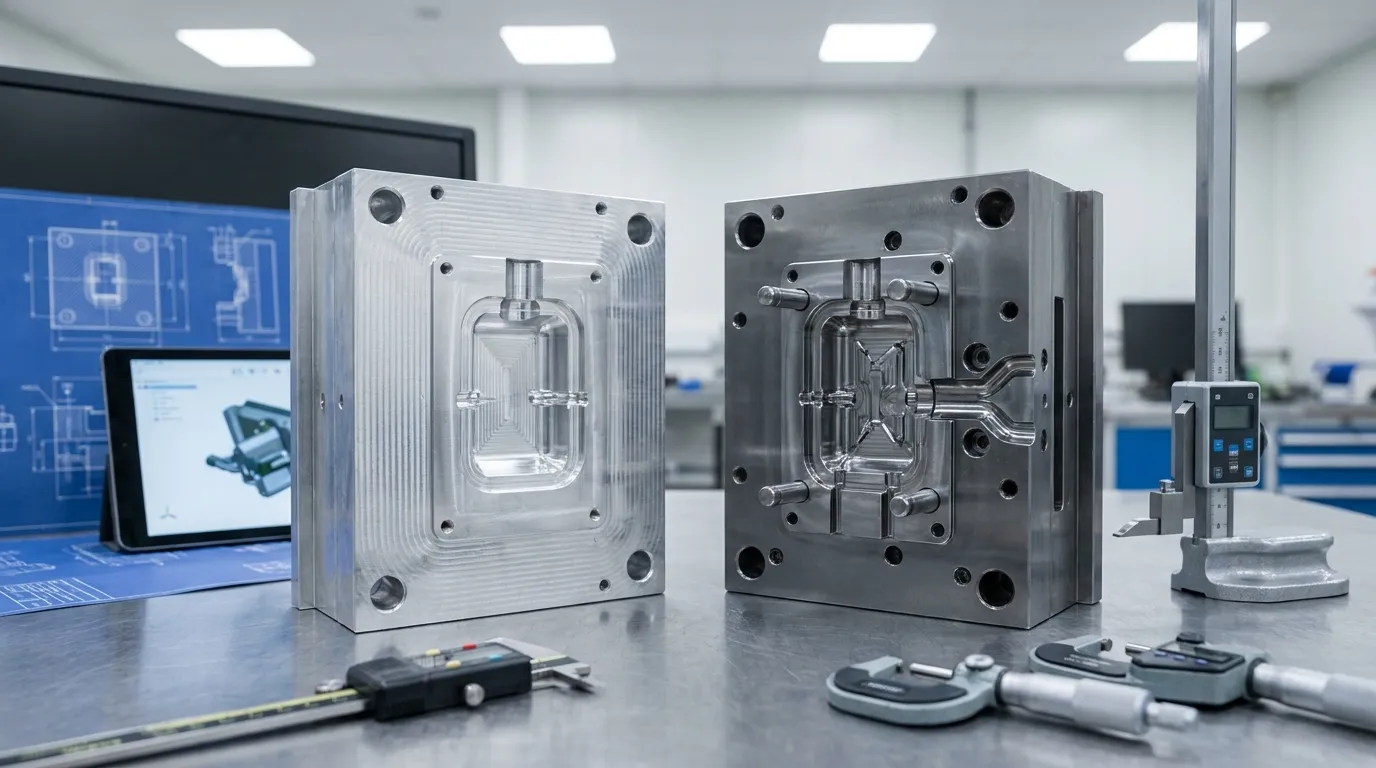
Aluminum molds reduce lead times and tooling cost for lower-volume projects, while hardened steel tooling is safer for long production runs and tighter tolerances.
Tooling material changes both project economics and production stability. Aluminum molds machine faster and cost less upfront, making them useful for prototyping, bridge production, or market testing.
Steel molds require more time and investment, but they handle higher production volumes and abrasive materials more reliably. Weilin Plastic notes that aluminum tooling is often preferred for low-volume manufacturing because of faster turnaround times.
Tooling Decision Table
| Factor | Aluminum Tooling | Steel Tooling |
|---|---|---|
| Lead time | Faster | Longer |
| Upfront cost | Lower | Higher |
| Production lifespan | Lower | Much higher |
| Revision flexibility | Easier | Harder |
| Best for | Prototypes, bridge runs | Long-term production |
Aluminum tooling is not always the cheapest long-term option. It works well for startup launches and pilot production, but hardened steel tooling is safer when repeatability and large production runs matter.
A startup launching a smart home device may choose aluminum tooling for the first 8,000 units. Once demand stabilizes, the company can transition to steel tooling for larger production volumes and improved durability.
If you're comparing tooling suppliers, review injection mold tooling before committing to a production plan.
What affects tooling cost and production pricing?
Tooling cost depends on part geometry, cavity count, resin behavior, tolerance requirements, and production volume. Small design changes after tooling starts can increase both lead time and total project cost.
Most injection molding costs fall into two categories: tooling cost and per-part production cost. Tooling includes machining, mold design, steel selection, cooling systems, and finishing work. Per-part cost depends on resin usage, cycle time, labor, and output volume.
Complex geometry increases tooling cost quickly. Undercuts, threaded sections, side actions, and polished cosmetic surfaces all require additional machining and engineering time.
| Cost Driver | Impact on Pricing |
|---|---|
| Multi-cavity mold | Higher tooling cost, lower part cost |
| Tight tolerances | More machining and validation |
| Engineering-grade resin | Higher material cost |
| Cosmetic finish | Additional polishing |
| Design revisions | Delays and rework |
The lowest mold quote is rarely the lowest total project cost. Weak DFM review and poor validation often create expensive corrections later.
For example, a buyer approving tooling before finalizing snap-fit geometry may face steel modifications after T1 sampling. Even small tooling revisions can delay production schedules and increase engineering costs.
When evaluating suppliers, a qualified custom molding supplier should explain cost drivers clearly instead of quoting only a single mold price.
How long does a custom injection molding project take?
Most custom plastic injection molding projects take several weeks to months depending on tooling complexity, revisions, sampling cycles, and production validation requirements.
Simple tooling projects may move from DFM approval to production in a few weeks. Complex hardened steel molds with multiple cavities and cosmetic requirements often take much longer. According to Aprios, production mold lead times can extend from several weeks to multiple months depending on complexity.
| Project Stage | Typical Timing |
|---|---|
| DFM review | 2-7 days |
| Mold design | 1-2 weeks |
| Tool fabrication | Several weeks |
| T1 sampling | Few days |
| Revisions and validation | Variable |
| Production ramp | Depends on approval |
Common causes of delay
Most delays come from project changes, not machine downtime. Late design revisions, incomplete specifications, resin changes, and failed validation rounds create the largest schedule disruptions.
A medical device project may require multiple T1 sampling rounds before dimensional stability meets approval standards. That extra validation time is normal in regulated production environments.
Evokpoly also highlights how tooling complexity and engineering changes affect overall lead time.
What should happen during sampling and production validation?
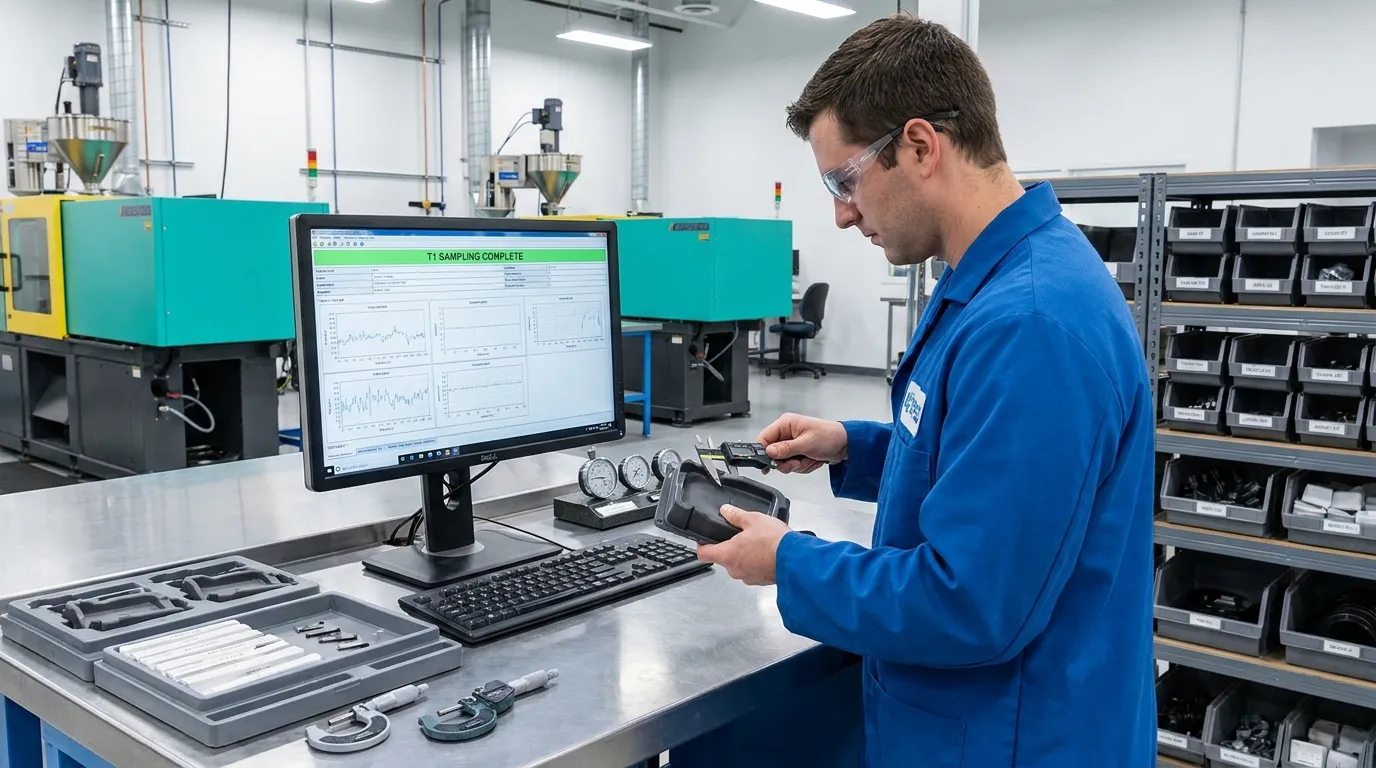
T1 sampling is where manufacturers validate dimensions, material behavior, and molding stability before full production begins. Skipping structured validation increases the risk of downstream defects and delays.
Sampling is the transition point between tooling completion and production readiness. The goal is not just to create acceptable parts. The goal is to prove the process can repeat stable results consistently.
Manufacturers usually inspect dimensions, cosmetic quality, gate performance, cooling behavior, and material consistency during T1 and follow-up validation rounds.
Production Readiness Checklist
- T1 sample approval
- Dimensional inspection report
- Resin verification
- Surface finish inspection
- Process parameter review
- Packaging approval
- Logistics planning review
- Revision tracking confirmation
A rushed production launch often creates avoidable quality problems. Faster production timing only helps if validation procedures are complete.
Before export shipment, some manufacturers also perform mold function testing and trial verification. Alpine Mold recommends reviewing trial reports, functionality, and dimensional checks before shipment approval.
For additional production-stage planning, review the mold validation process used during mold qualification and production release.
How can buyers reduce production delays and supply chain risk?
Most production delays come from design revisions, incomplete specifications, tooling changes, and poor production planning rather than machine downtime alone.
The best way to reduce delays is to lock specifications before tooling begins. Changing geometry, resin type, or surface finish after steel cutting usually affects tooling, validation, and scheduling.
International projects also require planning for customs paperwork, shipping schedules, and packaging requirements. Both Trade.gov and U.S. Customs and Border Protection provide guidance related to import procedures and shipment documentation.
| If This Happens | Risk Increases |
|---|---|
| Material changes after tooling | Sampling delays |
| Unclear tolerance specs | Inspection failures |
| No packaging review | Shipping damage |
| Weak communication cadence | Production confusion |
A buyer delaying steel cutting until DFM approval often saves far more money than a buyer rushing into production. Early discipline reduces revision cycles and keeps production schedules predictable.
Companies preparing for production scale-up should also review production planning support before approving long-term manufacturing agreements.
How do you choose the right injection molding manufacturer?
Choosing the right supplier depends on engineering support, quality systems, tooling capability, and communication quality. A manufacturer should help reduce production risk, not simply quote a mold price.
Buyers should evaluate whether the supplier handles DFM reviews, sampling reports, validation support, and export coordination internally. Clear engineering communication matters just as much as machine capacity.
Supplier Evaluation Checklist
- DFM engineering support
- Tooling experience
- Production capacity
- Quality inspection procedures
- Export and logistics experience
- Material sourcing controls
- Communication response time
- Revision management process
An experienced supplier should also explain where risk exists. For example, a supplier producing automotive parts may recommend hardened steel tooling immediately if annual production targets exceed projected aluminum mold lifespan.
If you're comparing long-term manufacturing partners, an experienced mold manufacturer should be able to explain tooling decisions, validation methods, and production scalability clearly.
Getting the Next Step Right
A successful custom plastic injection molding project depends on early planning, realistic timelines, and disciplined validation. Buyers who focus only on mold price often face higher costs later through revisions, delays, or unstable production.
Start by reviewing your production volume, material requirements, tolerance expectations, and launch timeline. Then evaluate whether aluminum or steel tooling fits the project long term. A supplier that supports DFM review, structured sampling, and production validation will usually reduce risk far more effectively than a low-cost quote alone.
Frequently Asked Questions
How much does custom plastic injection molding cost?
Costs depend on tooling complexity, resin selection, cavity count, cosmetic requirements, and production volume. The mold is usually the largest upfront expense, while per-part pricing becomes lower as production volume increases.
How long does it take to build an injection mold?
Simple molds may be completed within a few weeks, while complex hardened steel tooling can take several months. Sampling rounds, revisions, and validation requirements also affect the final production timeline.
Should tooling be made from aluminum or steel?
Aluminum tooling works well for prototypes and lower-volume production because it reduces cost and lead time. Steel tooling is better for large production runs, tighter tolerances, and longer mold lifespan.
Which plastic material should I use for my application?
Material selection depends on heat resistance, durability, flexibility, chemical exposure, and cosmetic requirements. Resin choice also affects tooling wear, cycle time, and long-term production consistency.
What certifications should I look for in an injection molding supplier?
Most buyers evaluate ISO compliance, quality management procedures, traceability systems, and industry-specific certifications. Medical and automotive programs often require stricter validation and inspection standards.
What causes delays in injection molding projects?
Design revisions after tooling starts, incomplete specifications, material changes, and failed validation rounds are common delay sources. Early DFM review helps reduce many of these production risks.
Share:



Written By Sunshine
At Sunshine, we are a professional manufacturer and supplier of precision mould components, offering a wide range of products for stamping and injection mould applications. Our core focus includes punching dies, ejector pins and sleeves, and guide posts and bushings. With advanced CNC machining, strict quality control, and strong production capabilities, we ensure reliable, high-precision parts, along with in-stock standard components for fast and efficient global supply.
NEWS
GET SERVICE
With quality parts to meet every budget and friendly staff trained to make your visit informative and hassle free.
