



Mold Manufacturing Process: Design Review, Machining, Assembly, and QC
Mold manufacturing starts with design review and DFM analysis, followed by CNC machining, EDM processing, mold assembly, testing, and quality control. A reliable mold manufacturing process reduces production defects, prevents expensive rework, shortens lead times, and helps manufacturers verify that a mold can run consistently before shipment approval.
A mold project can fail long before production starts. Poor DFM planning, loose tolerances, or rushed machining often create delays that show up during mold trials. That’s why experienced tooling suppliers focus heavily on process control from the first design review through final inspection. Understanding each stage helps buyers evaluate suppliers, reduce tooling risk, and avoid costly production issues later.
What are the main stages of mold manufacturing?
Mold manufacturing typically moves through design review, CNC machining, EDM processing, assembly, mold trials, and final quality inspection. Each stage affects lead time, dimensional accuracy, production stability, and long-term mold performance.
Most production molds follow a structured workflow. Manufacturers review the product design first, then confirm tolerances, material behavior, and molding feasibility before steel cutting begins. This early planning stage helps reduce expensive machining changes later.
After approval, the project moves into machining and component production. Shops use CNC milling, EDM, grinding, heat treatment, and polishing to produce precision mold parts. Once components are complete, technicians assemble and fit the mold before testing it in production conditions.
A standard mold production workflow usually includes:
- Design review and DFM analysis
- Mold design approval
- CNC machining and EDM
- Heat treatment and finishing
- Mold assembly and fitting
- Mold trial and sampling
- Final inspection and shipment approval
If you need a broader overview of tooling structure and terminology, this injection mold workflow guide explains how different mold systems and production stages connect.
Why does design review happen before machining?
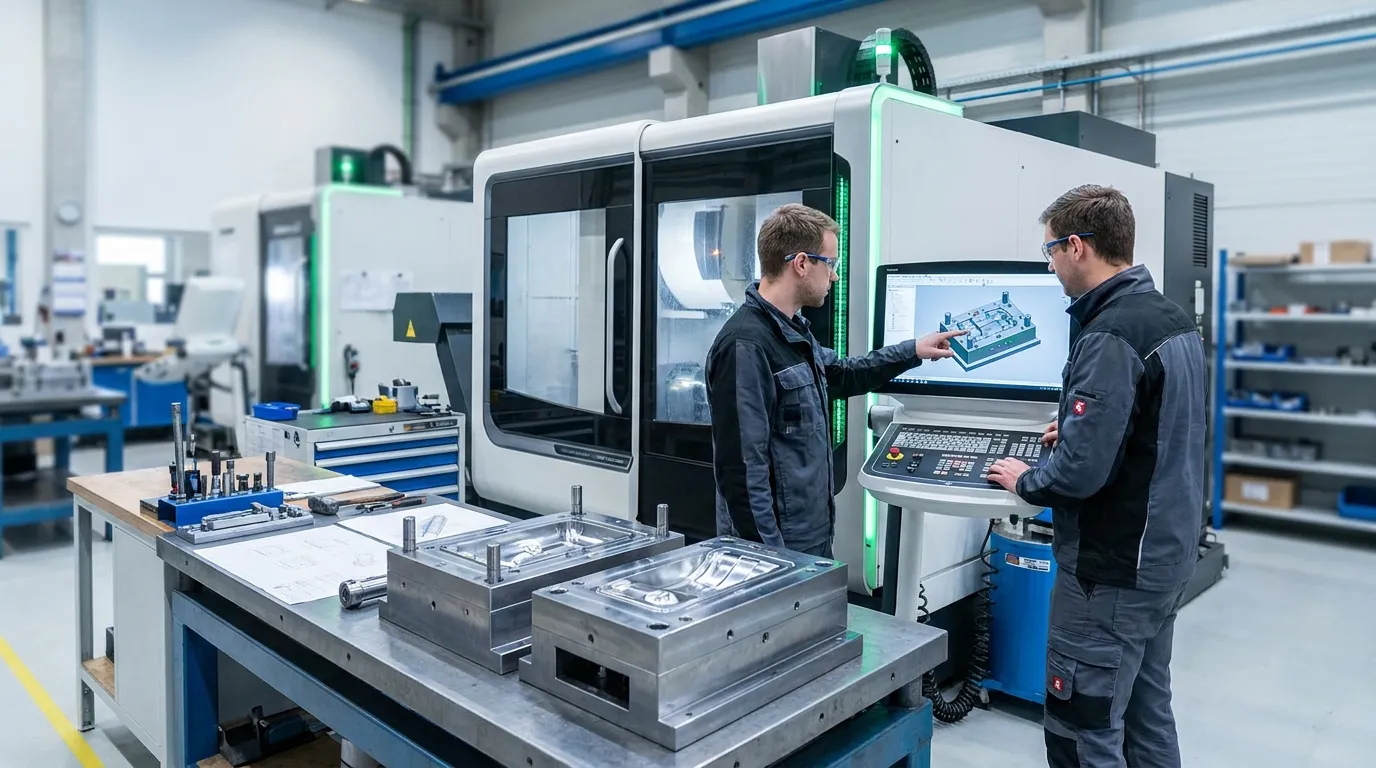
Design review happens before machining because tooling errors become expensive after steel cutting starts. Manufacturers use DFM analysis to verify part geometry, shrinkage, gate placement, cooling layout, and production feasibility before committing to machining.
DFM, short for Design for Manufacturability, helps mold manufacturers identify production risks early. Engineers review wall thickness, undercuts, draft angles, cooling paths, and material shrinkage before finalizing the tooling layout. A small geometry issue at this stage can create major rework after machining begins.
Fast tooling delivery is not always a sign of a better mold manufacturer. Some suppliers shorten lead time by reducing DFM review or trial validation. That approach can create larger production problems later, especially for high-volume molds with tight tolerances.
Common DFM issues found before machining
Common problems discovered during DFM review include:
- Uneven wall thickness causing warpage
- Poor gate location affecting filling balance
- Cooling layouts that increase cycle time
- Thin shutoff areas prone to wear
- Difficult ejector pin placement
A consumer electronics housing mold is a good example. During DFM review, engineers may discover that the original gate location creates visible weld lines near cosmetic surfaces. Adjusting the gate before machining is far cheaper than redesigning hardened steel later.
For a broader explanation of tooling structure and part design, see this plastic injection mold design resource or explore the complete mold components guide for component-level details.
How are mold components machined and finished?
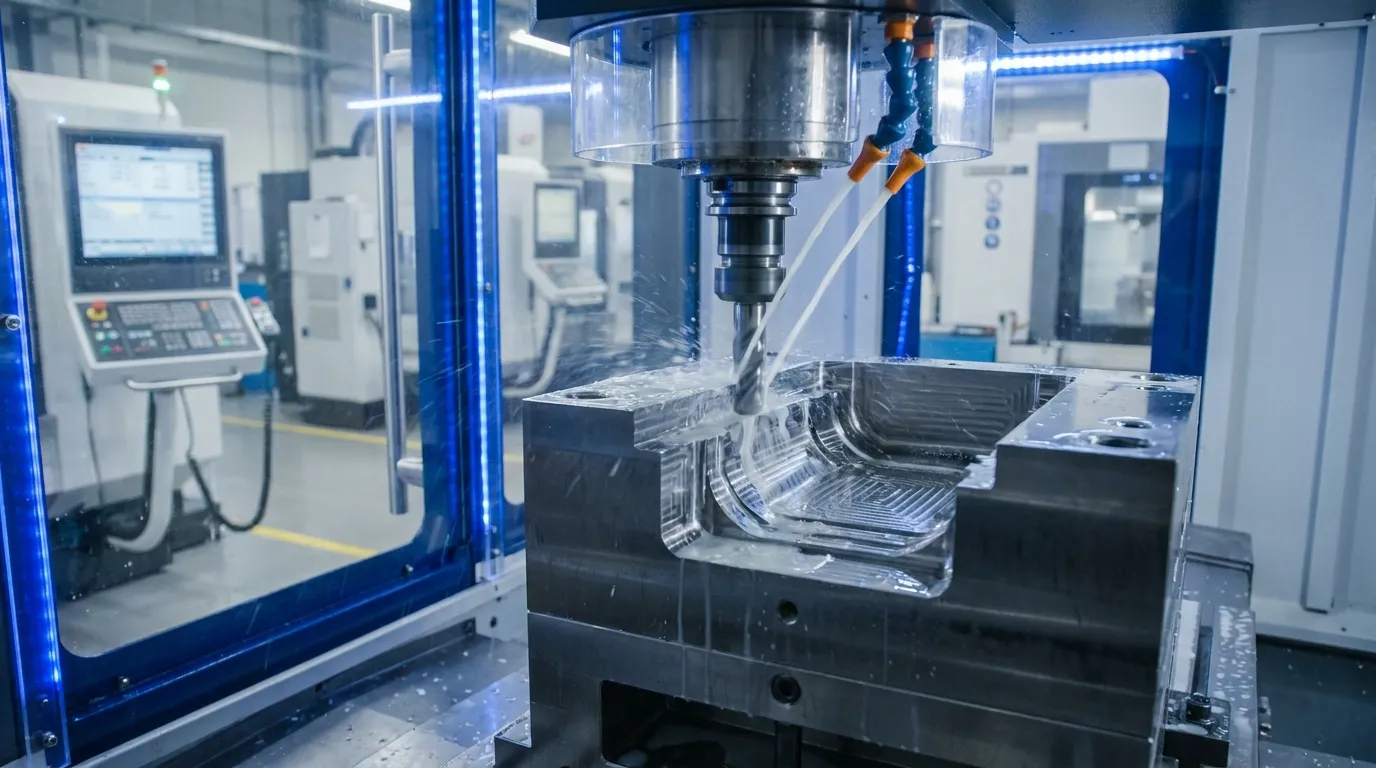
Mold manufacturers use CNC machining, EDM, grinding, and polishing to create precise mold components. The machining sequence depends on geometry complexity, tolerance requirements, surface finish targets, and production volume expectations.
Machining starts with raw tool steel blocks. CNC milling machines remove material to create mold bases, cavities, cores, cooling channels, and ejector layouts. Shops often rough-machine components first, then leave extra stock for finishing operations after heat treatment.
CNC machining operations
CNC equipment handles most standard mold geometry. High-speed milling improves surface finish and dimensional consistency, especially for hardened steel molds used in automotive or medical production.
Typical CNC operations include:
| Operation | Purpose |
|---|---|
| Rough milling | Removes large amounts of steel |
| Finish milling | Achieves final dimensions |
| Drilling | Creates cooling channels |
| Tapping | Adds threaded features |
| High-speed milling | Improves surface finish |
EDM, grinding, and polishing
EDM, or electrical discharge machining, is used for deep ribs, sharp corners, and complex geometries that standard cutters cannot reach. Grinding improves flatness and tolerance accuracy, while polishing prepares cosmetic surfaces.
An automotive dashboard mold may require additional EDM work after trial sampling reveals minor warpage near thin rib sections. This type of adjustment is common during mold refinement.
A mold that passes dimensional inspection once is not automatically production-ready. Stable repeatability during mold trials matters more than a single successful sample.
Precision alignment parts also affect long-term performance. These precision mold components help maintain cavity alignment, reduce wear, and improve consistency during repeated production cycles.
How does mold assembly and fitting work?
Mold assembly combines machined components into a functioning tooling system with aligned cores, cavities, ejectors, cooling channels, and guide elements. Proper fitting reduces flash, wear, dimensional variation, and premature maintenance issues.
After machining is complete, technicians begin fitting all mold components together. This stage includes cavity alignment, ejector system installation, cooling connection setup, slide fitting, and movement testing. Small alignment errors can affect part quality, cycle time, and mold life.
Assembly teams also check shutoff surfaces and moving components for smooth operation. Flash problems often begin with poor fitting or inconsistent parting line contact. Shops usually perform manual spotting and adjustment work before trial molding starts.
Key assembly checks include:
- Guide pin alignment
- Ejector movement
- Cooling channel sealing
- Slide travel verification
- Parting line contact inspection
Low tooling cost can increase long-term production cost if the mold requires constant maintenance or unstable cycle performance. Proper fitting work often separates reliable production molds from short-life tooling.
These guide posts and bushings play a major role in maintaining alignment during repeated mold opening and closing cycles.
What quality control checks happen before shipment?
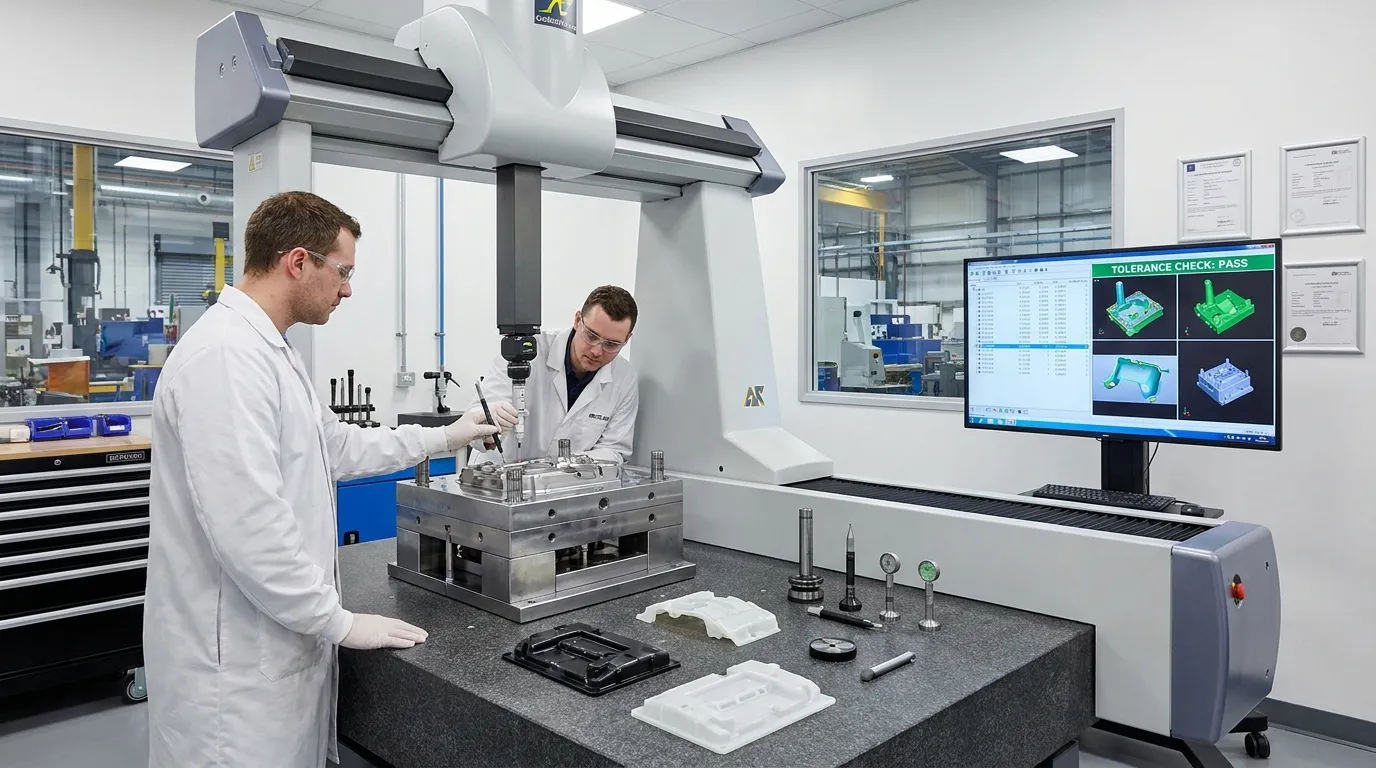
Quality control in mold manufacturing includes dimensional inspection, mold trial validation, fit verification, and sample-part testing. Manufacturers typically confirm tolerances, surface finish, cooling performance, and stable molding conditions before shipment.
QC starts long before final shipment. Shops inspect components during machining, after heat treatment, during assembly, and again after trial production. Coordinate measuring machines, often called CMM systems, are commonly used for dimensional verification.
First article inspection
First article inspection confirms that the mold produces parts within specification. Manufacturers usually compare molded samples against approved drawings, cosmetic standards, and assembly requirements before customer approval.
A medical device enclosure mold may require additional documentation and repeatability testing before acceptance. Tight tolerance projects often include multiple sample runs to verify stable dimensions across repeated cycles.
Mold Manufacturing QC Checklist
| QC Check | Purpose |
|---|---|
| Dimensional inspection | Confirms cavity accuracy |
| Surface finish check | Prevents cosmetic defects |
| Cooling verification | Stabilizes cycle time |
| Ejector testing | Confirms reliable release |
| Mold trial sampling | Verifies production readiness |
| Fit inspection | Prevents flash and wear |
| Repeatability testing | Confirms stable dimensions |
Lead time can increase when trial samples fail dimensional inspection or cooling performance checks. According to Evok Poly and Aprios, production molds often require additional validation and refinement before final approval.
If you're comparing tooling categories across industries, this guide to industrial mold applications explains how mold requirements change by production environment.
What usually delays mold manufacturing projects?
Mold manufacturing delays usually come from late design changes, machining rework, trial failures, material shortages, or unresolved dimensional problems. Small DFM mistakes early in the project can create multi-week delays later during testing and validation.
Most tooling delays begin before the mold reaches production trials. Poor communication during design review, unclear tolerance expectations, or incomplete product drawings can create rework after machining starts.
A consumer electronics housing project might require a gate redesign during mold testing after weld lines appear on visible surfaces. Even small geometry changes can delay delivery by several weeks because machining, polishing, and validation all need revision.
Mold Delay Risk Table
| Delay Cause | Typical Impact | Prevention Method | Recovery Action |
|---|---|---|---|
| Late design changes | Re-machining | Freeze design earlier | Revise tooling schedule |
| Trial molding failure | Additional sampling | Better DFM review | Adjust processing parameters |
| Material shortage | Schedule delays | Early steel ordering | Substitute approved material |
| Cooling imbalance | Longer cycle time | Simulation review | Modify cooling channels |
| Dimensional mismatch | QC rejection | Tolerance planning | Rework cavity surfaces |
According to PowerfulSky, trial parameter mismatch and gate redesign are common reasons for mold schedule overruns. HH Molds also emphasizes that stronger DFM and QC planning reduces production launch problems.
For a broader look at scheduling and process flow, this mold production timeline guide explains how tooling stages affect delivery expectations.
How do manufacturers validate a mold before production?
Manufacturers validate a mold by running trial production cycles, checking repeatability, verifying dimensions, and confirming stable process conditions. The goal is to prove that the mold can produce consistent parts before shipment approval.
Trial sampling and approval
Trial molding usually starts with short production runs. Engineers adjust injection pressure, cooling time, holding pressure, and cycle parameters while monitoring part quality. This stage helps identify flash, warpage, sink marks, or dimensional drift.
A high-cavity packaging mold may require cooling-channel adjustments after trial runs reveal unstable cycle times between cavities. These refinements improve consistency before full-scale production begins.
Manufacturers also evaluate repeatability across multiple cycles. Stable production matters more than a single acceptable sample. Buyers should ask for dimensional reports, sample approvals, and trial documentation before approving final shipment.
For additional information about production-ready tooling systems, this production mold validation resource explains how molds transition from testing into full manufacturing use.
Getting the Next Step Right
A successful mold manufacturing project depends on more than fast machining or low tooling cost. Design review, QC planning, assembly accuracy, and production validation all affect long-term performance. Buyers who understand the workflow can identify risk earlier and ask better questions before approving a supplier.
If you're evaluating a new tooling project, focus on how the manufacturer handles DFM review, trial validation, and inspection control. Those stages usually determine whether a mold performs reliably in production or creates expensive problems later.
Frequently Asked Questions
How long does mold manufacturing take?
Most production molds take several weeks to several months depending on complexity, cavity count, machining requirements, and validation testing. Mold trials and design revisions often add extra time before production approval.
Why is DFM important in mold manufacturing?
DFM helps manufacturers identify production risks before steel cutting begins. Early review reduces rework and prevents delays caused by shrinkage issues, poor cooling layout, or incorrect gate placement.
What machines are used in mold manufacturing?
Manufacturers commonly use CNC milling machines, EDM equipment, grinding machines, polishing systems, and coordinate measuring equipment. Each process supports dimensional accuracy and surface finish control.
What causes mold delivery delays?
Design changes, machining errors, failed mold trials, and material sourcing problems are common causes of delay. Poor communication during DFM review can also create expensive rework later in the project.
How is mold quality checked?
Manufacturers use dimensional inspection, mold trial sampling, fit verification, and sample-part validation to confirm mold quality. Inspection usually happens throughout machining, assembly, and final testing stages.
Should tooling be aluminum or steel?
Steel molds usually provide better durability and longer production life for high-volume manufacturing. Aluminum molds can reduce tooling time and cost for prototypes or lower-volume production runs.
Share:



Written By Sunshine
At Sunshine, we are a professional manufacturer and supplier of precision mould components, offering a wide range of products for stamping and injection mould applications. Our core focus includes punching dies, ejector pins and sleeves, and guide posts and bushings. With advanced CNC machining, strict quality control, and strong production capabilities, we ensure reliable, high-precision parts, along with in-stock standard components for fast and efficient global supply.
NEWS
GET SERVICE
With quality parts to meet every budget and friendly staff trained to make your visit informative and hassle free.
