



Mold Design for Injection Molding: Key Decisions That Affect Cost and Quality
Mold design for injection molding affects tooling cost, part quality, cycle time, and mold lifespan. Decisions like cavity count, cooling layout, venting, gate placement, and mold steel selection determine whether a tool runs efficiently or creates recurring defects, delays, and maintenance problems. Buyers should match mold design choices to production volume, tolerance requirements, and long-term manufacturing goals before approving tooling.
A mold can look good on paper and still create expensive production issues later. Small design decisions often determine whether parts run consistently for years or require constant adjustments and repairs. Understanding those tradeoffs early helps buyers avoid redesign delays, unnecessary tooling costs, and quality problems that are difficult to fix after steel cutting begins.
Which mold design decisions affect cost and quality the most?
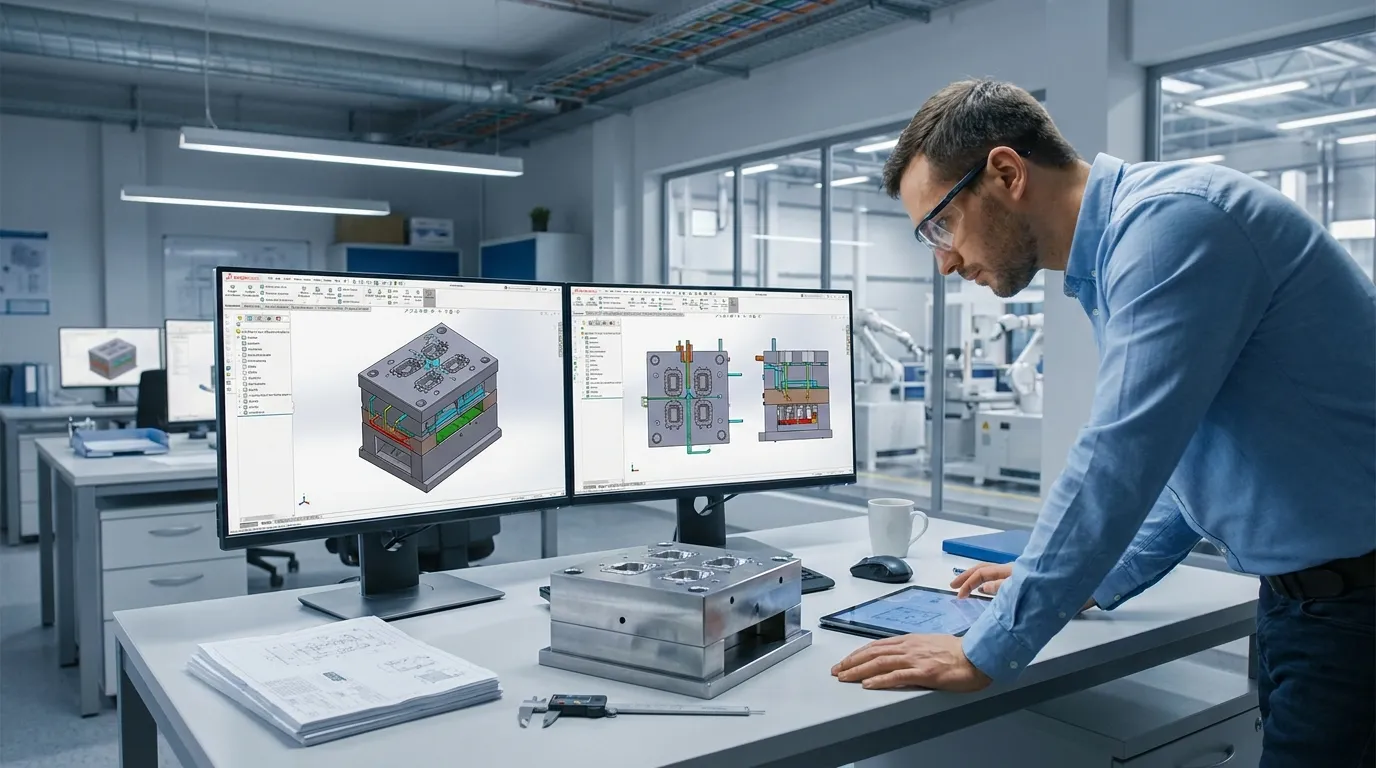
Mold design for injection molding directly affects tooling cost, part quality, cycle time, and mold life. Decisions like cavity count, cooling layout, gate placement, and steel selection influence both upfront tooling expense and long-term production stability.
The biggest mold design decisions usually involve cavity count, cooling layout, venting, gate location, and mold material. These factors control how evenly plastic flows, how quickly parts cool, and how consistently dimensions stay within tolerance.
Poor decisions in any of these areas can increase scrap rates, maintenance time, and cycle delays. A mold with weak cooling design, for example, may still produce acceptable parts, but the machine may need slower cycle times to prevent warpage and sink marks.
For buyers new to tooling projects, reviewing basic injection mold design basics before approving production can prevent costly revisions later.
Mold Design Tradeoff Table
| Design Choice | Upfront Cost Impact | Quality Impact | Cycle Time Impact | Maintenance Impact |
|---|---|---|---|---|
| Multi-cavity mold | Higher | Better output consistency if balanced correctly | Faster total production | More complex maintenance |
| Advanced cooling channels | Higher | Reduces warpage and sink marks | Shorter cycles | Lower long-term adjustments |
| Hardened steel tooling | Higher | Better dimensional stability | Stable over long runs | Longer tool life |
| Simple venting design | Lower | Higher risk of burn marks and flash | Can slow processing | More troubleshooting |
| Optimized gate placement | Moderate | Better filling and cosmetics | More stable production | Fewer revisions |
A common mistake is assuming the most complex mold automatically delivers the best value. Multi-cavity molds and ultra-tight tolerances can improve output, but they also increase balancing requirements, inspection effort, and repair complexity. In lower-volume programs, simpler tooling often produces a better return.
For broader terminology and tooling concepts, the mold components guide provides a more complete overview of mold structures and functions.
How does cavity count change tooling cost and production economics?
Multi-cavity molds reduce per-part cost at higher production volumes, but they increase tooling complexity, balancing requirements, maintenance effort, and inspection demands. Lower-volume projects often benefit more from simpler single-cavity tooling.
Cavity count directly affects both tooling investment and production efficiency. A single-cavity mold costs less upfront and is easier to maintain, but it produces fewer parts per cycle. Multi-cavity molds increase output and reduce unit cost over time, especially in large production runs.
The tradeoff is complexity. Multi-cavity molds require balanced filling, more precise cooling, and tighter process control. If one cavity starts producing inconsistent parts, the entire production run can become harder to manage.
| Mold Type | Best For | Main Advantage | Main Limitation |
|---|---|---|---|
| Single-cavity | Prototypes, low-volume runs | Lower tooling cost | Lower output |
| Two to four cavities | Medium production | Balanced cost and throughput | More maintenance |
| High-cavity production molds | Large-scale manufacturing | Lowest unit cost at scale | Complex balancing and inspection |
A startup consumer electronics company may only need 20,000 units in the first year. In that situation, a simpler aluminum single-cavity tool could launch production faster and avoid unnecessary tooling expense. A hardened steel eight-cavity mold may only make sense after demand becomes predictable.
Buyers comparing production strategies often review custom molding production support options to estimate when higher-output tooling becomes financially practical.
Should you choose aluminum or hardened steel molds?
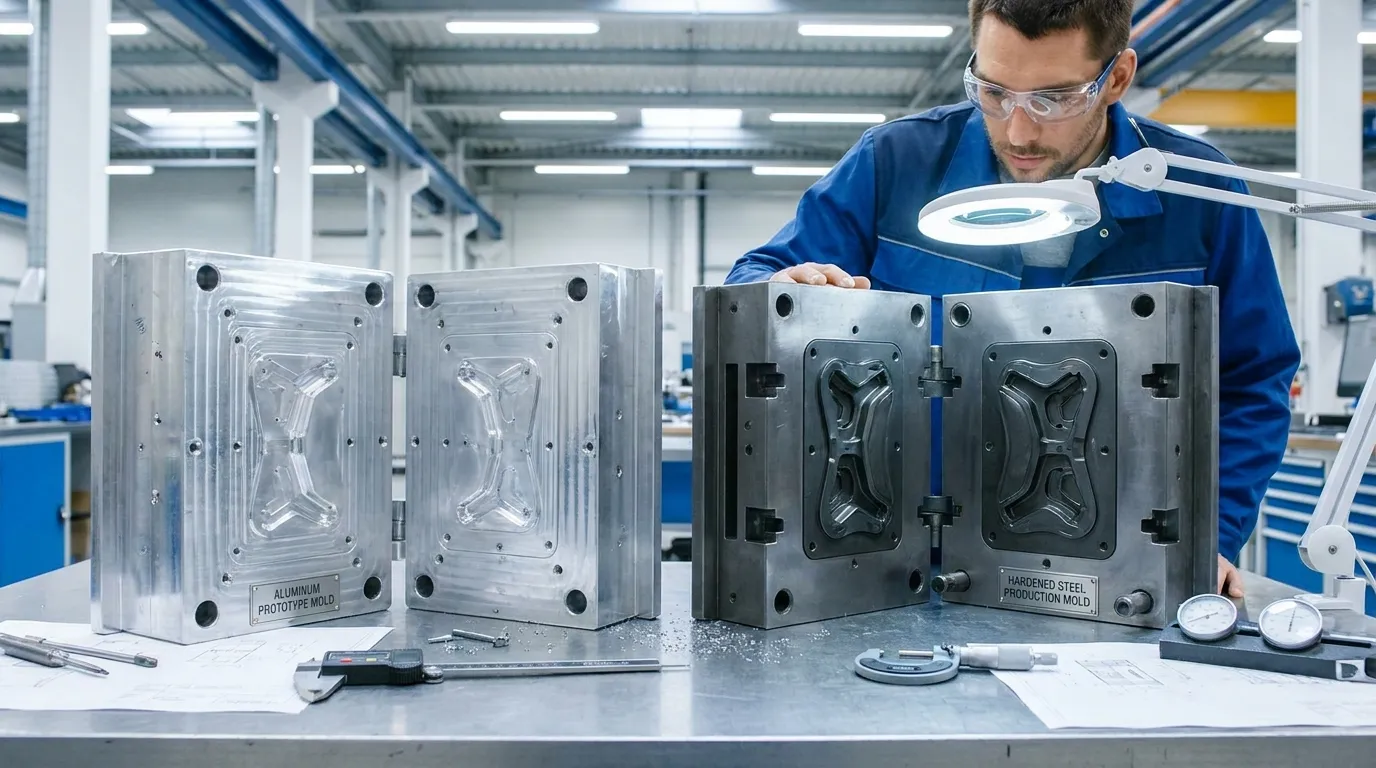
Aluminum molds reduce tooling lead time and upfront cost, making them suitable for prototypes and low-volume production. Hardened steel molds cost more initially but deliver longer tool life, better wear resistance, and stronger dimensional consistency.
The right tooling material depends on expected production volume, resin type, and precision requirements. Aluminum molds are easier and faster to machine, which helps companies launch products quickly. Hardened steel molds require more investment but hold tolerances better during long production runs.
According to a Texas A&M mold design reference, hardened steel tooling generally provides better wear resistance and longer operational life than softer tooling materials. The engineering guide also notes that tooling selection should match production demand and material conditions.
When aluminum tooling makes sense
Aluminum tooling works well for prototypes, bridge production, and lower-volume industrial parts. It can reduce lead times significantly, which matters when a product launch deadline is tight.
A low-volume industrial product may only need 10,000 parts annually. In that case, paying for hardened steel tooling may extend ROI far beyond what the project requires.
When hardened steel is safer
Steel molds become the safer option when production volume increases or tolerances become stricter. Medical, automotive, and electronics projects often require stable dimensions across long production runs.
A medical device supplier producing sealing components may need extremely consistent dimensions across millions of cycles. In that situation, hardened steel helps maintain repeatability while reducing wear-related variation over time.
Companies evaluating tighter tolerance applications often compare high precision molding requirements before selecting final tooling materials.
Why do cooling channel design and venting matter so much?
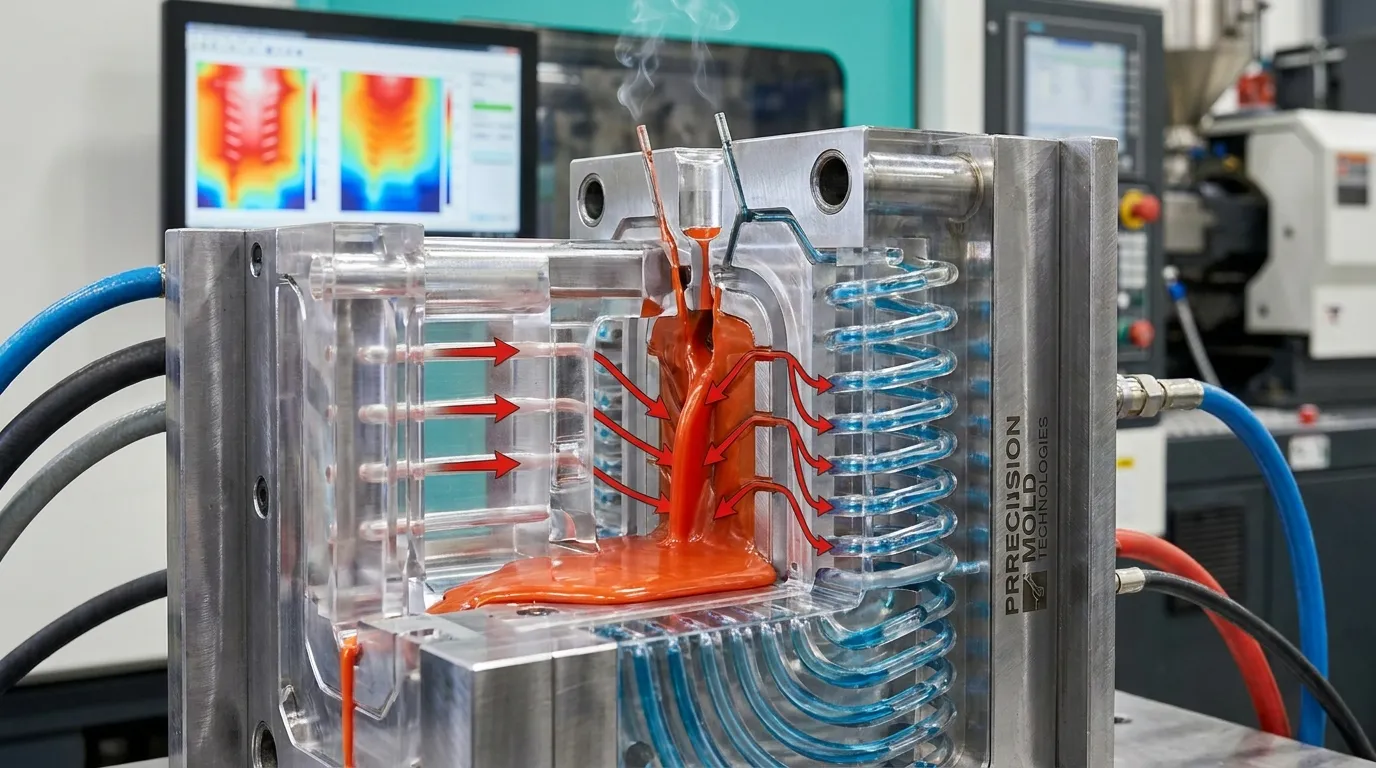
Cooling layout and venting strongly influence cycle time, dimensional stability, and defect prevention. Poor cooling creates uneven shrinkage and warpage, while poor venting traps gas that can cause burn marks, flash, and incomplete filling.
Cooling channels control how heat leaves the mold during production. If cooling is uneven, different sections of the part shrink at different rates. That creates warpage, sink marks, and dimensional variation.
Research on injection molding process behavior has shown that cooling consistency strongly affects warpage and final part stability. Studies examining molding variation continue to link cooling conditions to dimensional accuracy and repeatability. Recent analysis of molding variation highlights how process and cooling variables contribute to distortion problems.
Venting is equally important. Trapped gas creates pressure pockets during filling, which can lead to burn marks, short shots, or flash around the parting line.
Common Cooling and Venting Problems
- Uneven cooling causes warpage
- Poor venting creates trapped gas
- Inconsistent temperature control slows cycle time
- Excessive injection pressure increases flash risk
- Weak cooling layouts reduce dimensional stability
A packaging manufacturer dealing with long cycle times may initially try increasing machine speed. In many cases, redesigning cooling channels produces better results because the mold removes heat more efficiently. That improves output without increasing stress on the machine.
Companies focused on dimensional consistency often review precision molding process strategies to improve cooling performance and production stability.
How do draft angles, parting lines, and gate placement affect manufacturability?
Draft angles, gate placement, and parting line decisions determine how easily parts release from the mold and how consistently resin flows. Poor choices increase flash, cosmetic defects, maintenance needs, and tooling revisions.
These features may seem minor during design review, but they strongly influence long-term manufacturability. Draft angles help parts release from the mold cleanly. Without enough draft, parts can stick during ejection and damage surfaces over time.
Gate placement controls how molten resin enters the cavity. Poor gate locations create uneven filling patterns, visible flow marks, and inconsistent shrinkage. Parting line placement also affects flash risk and cosmetic appearance.
Gate placement mistakes that increase defects
Gates positioned too close to cosmetic surfaces can leave visible marks or uneven flow patterns. Gates placed in areas with restricted flow may also create weld lines and weak points.
A redesign delay often starts here. One supplier may cut steel before confirming optimal gate placement. If testing later reveals uneven filling, the tool may require welding and re-machining. According to tooling timeline guidance, late-stage tooling changes frequently extend project schedules.
Why parting line location matters
Parting lines determine where mold halves separate. Poor placement increases flash risk and may create visible seams on cosmetic surfaces.
This is one area where overengineering can backfire. Extremely complex parting line designs may improve appearance slightly, but they can also increase maintenance difficulty and tooling cost. Simpler layouts often provide better long-term production stability.
Teams evaluating broader tooling strategies can review mold tooling decisions before finalizing manufacturability requirements.
When does high-precision mold design actually pay off?
High-precision tooling is valuable when assemblies, sealing surfaces, or strict tolerances are critical. For many consumer products, excessive precision increases tooling and inspection costs without delivering meaningful functional benefits.
Precision tooling increases machining time, inspection requirements, and maintenance effort. That investment makes sense for parts that must fit tightly within assemblies or maintain sealing performance under load.
Medical devices, electronics housings, and precision connectors often require strict dimensional control. In those cases, higher tooling precision reduces assembly issues and improves long-term consistency.
| Application Type | Precision Requirement | Recommended Tooling Approach |
|---|---|---|
| Consumer packaging | Moderate | Standard production tooling |
| Medical sealing parts | Very high | Hardened steel precision tooling |
| Consumer electronics housings | High | Precision-controlled tooling |
| Industrial utility parts | Moderate | Simplified durable tooling |
High-precision tooling is frequently oversold for general consumer products. A basic storage container or industrial cover may function perfectly within standard tolerances. Adding extreme precision only increases machining and inspection costs without improving performance.
A medical device manufacturer producing fluid-control components faces a different situation. Small dimensional variation can affect sealing performance, so tighter process control becomes necessary. Buyers handling those applications often review precision tooling requirements before approving mold construction.
What should buyers review before approving mold production?
Tooling approval should happen only after manufacturability, cooling, material selection, and tolerance requirements are fully reviewed. Changes after steel cutting often create delays, extra machining costs, and longer validation cycles.
Before approving production, buyers should confirm that the DFM review addresses part geometry, gate placement, venting, cooling layout, and maintenance access. Missing details in these areas usually become expensive problems later.
Mold Approval Checklist
- DFM review completed
- Gate locations approved
- Cooling layout validated
- Resin material confirmed
- Tolerance requirements documented
- Maintenance expectations reviewed
- Production volume assumptions verified
- Cosmetic surface expectations approved
A late gate change can easily delay a project by several weeks if tooling modifications require welding and re-machining. That risk becomes larger on multi-cavity production molds because balancing conditions also change after revisions.
Manufacturers preparing for production often coordinate injection molding support early to reduce redesign risk and improve tooling approval accuracy.
Getting the Next Step Right
Good tooling decisions are usually practical, not extreme. The best mold design for injection molding balances production volume, quality expectations, cycle time, maintenance demands, and long-term cost control. A simpler mold may outperform a more expensive design if the production requirements do not justify added complexity.
Before approving tooling, review the full production plan, not just the initial quote. Ask how the mold will handle maintenance, dimensional stability, inspection requirements, and future production scaling. Small design choices made early often determine whether a tool performs reliably for years or creates recurring production problems.
Frequently Asked Questions
How long does it take to make an injection mold tool?
Injection mold lead time depends on mold complexity, cavity count, and tooling material. Prototype aluminum molds may take only a few weeks, while hardened steel production molds usually require longer engineering, machining, and validation time.
What determines the cost of plastic molding?
Mold complexity, cavity count, mold steel, tolerance requirements, and expected production volume all affect tooling cost. Advanced cooling systems and tighter tolerances also increase machining and inspection requirements.
Why is tooling DFM important in injection molding?
Tooling DFM identifies manufacturability risks before steel cutting begins. Early review helps reduce redesign delays, tooling modifications, cycle time inefficiencies, and recurring production defects.
What causes warpage in injection molding?
Warpage usually results from uneven cooling, inconsistent shrinkage, poor gate placement, or material flow imbalance. Mold cooling design and process stability both affect dimensional accuracy.
Should I use aluminum or steel injection molds?
Aluminum molds work well for prototypes and low-volume production because they reduce tooling cost and lead time. Steel molds are better for high-volume production, abrasive materials, and long-term dimensional consistency.
How many cavities should an injection mold have?
The right cavity count depends on production volume, cycle time goals, tooling budget, and quality control requirements. Higher cavity counts improve throughput but also increase tooling complexity and maintenance demands.
Share:



Written By Sunshine
At Sunshine, we are a professional manufacturer and supplier of precision mould components, offering a wide range of products for stamping and injection mould applications. Our core focus includes punching dies, ejector pins and sleeves, and guide posts and bushings. With advanced CNC machining, strict quality control, and strong production capabilities, we ensure reliable, high-precision parts, along with in-stock standard components for fast and efficient global supply.
NEWS
GET SERVICE
With quality parts to meet every budget and friendly staff trained to make your visit informative and hassle free.
