



Precision Components for Molds: When Accuracy and Wear Resistance Matter
Precision components for molds are high-tolerance parts that improve alignment, repeatability, and wear resistance in injection mold systems. Components such as guide posts, ejector pins, and bushings need tight dimensional control to reduce flash, uneven wear, and part variation. The right material, coating, and inspection process can extend mold life and maintain stable production quality across long manufacturing runs.
A mold can look well-built on paper and still fail in production because of small component inaccuracies. Misalignment, surface wear, and tolerance drift often start with the parts that guide, position, and eject material inside the mold. For manufacturers running high-volume production, precision components are not just about tighter machining. They affect maintenance costs, scrap rates, and long-term mold stability.
What are precision components in mold manufacturing?
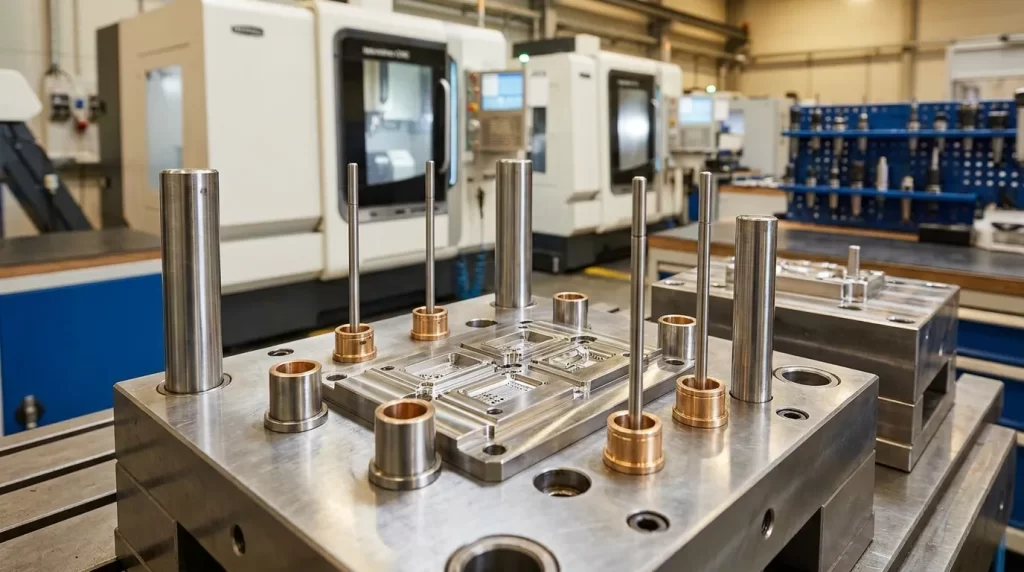
Precision components in molds are high-tolerance parts designed to maintain alignment, repeatability, and dimensional accuracy during repeated production cycles. They reduce variation, minimize wear-related defects, and improve mold lifespan.
In mold manufacturing, precision components refer to parts that must maintain exact positioning under repeated mechanical stress. These components include guide posts, bushings, ejector pins, sleeves, and cavity inserts. Even a small dimensional shift can create flash, sticking, or inconsistent plastic parts.
The need for precision becomes more obvious in high-cycle molds. A mold producing thousands of parts each day cannot rely on loose-fitting components. Wear increases quickly when alignment drifts, especially in molds processing abrasive resins or thin-wall parts.
Manufacturers often use hardened tool steels, precision grinding, EDM machining, and advanced inspection systems to maintain dimensional consistency. A broader overview of mold systems and component categories is available in this complete mold components guide.
For buyers comparing suppliers, the key issue is not just machining capability. It is whether the supplier can maintain repeatability over long production runs using properly engineered precision mold components.
Which mold components require the highest precision?
Guide systems, ejector components, and cavity alignment parts usually require the highest precision because even small dimensional variation can create flash, mismatch, premature wear, or unstable part quality.
Not every mold component needs micron-level tolerances. Some areas are far more sensitive to dimensional variation than others. Guide systems and moving parts usually experience the highest stress and alignment pressure during production.
Guide systems
Guide posts and bushings control mold alignment during opening and closing. If these parts wear unevenly, cavity surfaces may no longer match correctly. That often causes flash on finished parts or visible mismatch lines.
Automotive trim molds are a common example. A guide-post tolerance difference as small as ±0.01 mm can affect visible surface quality on exterior plastic parts.
Ejector systems
Ejector pins and sleeves require smooth movement and consistent positioning. Excess friction or slight misalignment increases wear and can damage molded parts during ejection.
In high-volume electronics production, ejector pins often fail early because of short cycle times and repeated friction contact. Poor alignment accelerates galling and surface scoring.
| Mold Component | Why Precision Matters | Common Failure Risk |
|---|---|---|
| Guide posts | Maintains mold alignment | Flash and mismatch |
| Bushings | Controls movement stability | Uneven wear |
| Ejector pins | Supports clean part release | Pin sticking |
| Core inserts | Maintains dimensional accuracy | Part inconsistency |
| Sleeves | Reduces friction movement | Surface scoring |
Manufacturers sourcing mold alignment parts should focus on repeatability and wear performance instead of chasing the tightest possible tolerance everywhere.
What tolerance range is considered high precision for mold components?
High-precision mold components commonly operate within ±0.01 mm tolerance or tighter depending on mold complexity, resin type, and production volume requirements.
Tolerance requirements depend on the mold application. Thin-wall packaging molds and medical molds usually require tighter dimensional control than general consumer products. According to Attur International, precision machining applications often operate within ±0.01 mm tolerance ranges.
That does not mean every component should be machined to the tightest possible limit. Ultra-tight tolerances are not automatically better. If the mold application does not require them, they can increase cost without improving production stability.
| Application Type | Typical Tolerance Requirement |
|---|---|
| General mold components | ±0.02 mm |
| Precision alignment parts | ±0.01 mm |
| Thin-wall molding | ±0.005 mm |
| Medical or micro molding | Below ±0.005 mm |
Tolerance planning should match actual production conditions. High-volume molds processing abrasive materials usually benefit more from stable wear resistance than from unnecessary ultra-fine tolerances.
Why does wear resistance matter in injection molds?
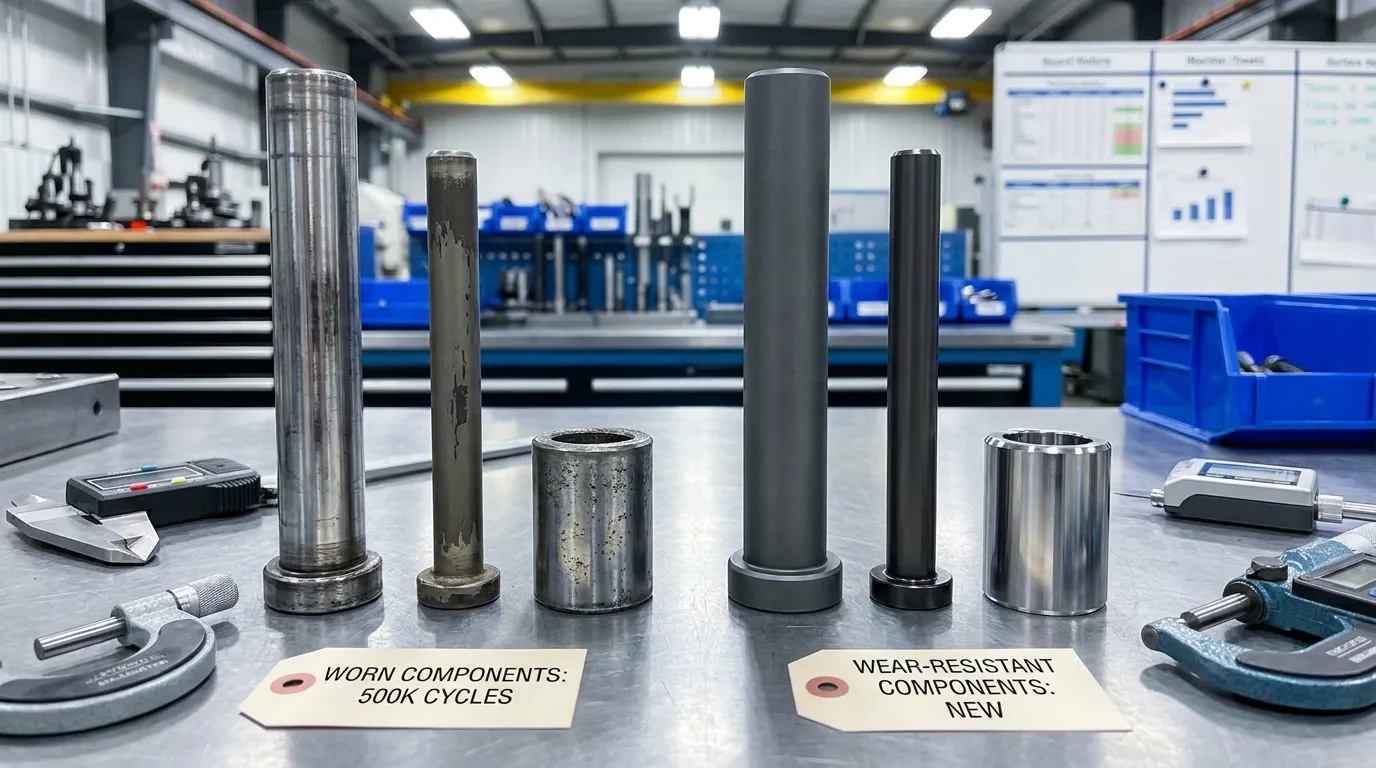
Wear resistance directly affects mold lifespan, cycle stability, and part consistency. Poor wear performance increases maintenance frequency, dimensional drift, and the risk of flash or sticking during production.
Mold components experience repeated friction, pressure, and heat during production. Over time, these forces remove material from contact surfaces and reduce alignment accuracy. Once wear begins, dimensional variation spreads quickly through the entire mold system.
Abrasive plastics make the problem worse. Glass-filled resins and engineering plastics create higher friction loads that accelerate surface damage. Components that start with weak hardness or poor surface treatment often fail much earlier than expected.
Common wear points
The most common wear locations include:
- Guide posts and bushings
- Ejector pins
- Sliding cores
- Shut-off surfaces
- Sleeves and moving inserts
Coatings help, but they cannot compensate for poor alignment or weak base material selection. A nitrided surface on a poorly fitted guide system will still wear unevenly under repeated load.
Mold Wear Failure Checklist
| Warning Sign | Likely Cause | Recommended Action |
|---|---|---|
| Flash on molded parts | Alignment wear | Inspect guide system |
| Pin sticking | Surface galling | Replace or coat ejector pins |
| Uneven cavity wear | Poor hardness | Upgrade material grade |
| Surface scoring | Friction damage | Improve lubrication |
| Frequent maintenance | Weak wear resistance | Review coating strategy |
For manufacturers comparing wear-resistant mold parts, the better long-term choice is often the component that reduces downtime rather than the one with the lowest purchase price.
Which materials and coatings improve mold component lifespan?
High-grade tool steels combined with surface treatments like nitriding or PVD coatings improve hardness, reduce friction, and extend the operating life of precision mold components under repeated production stress.
Material selection affects both wear resistance and dimensional stability. Hardened tool steels are common because they maintain strength under repeated mechanical load. Surface treatments improve resistance to friction and abrasion without changing the entire component structure.
Nitriding is widely used because it hardens the outer surface while maintaining core toughness. PVD coatings reduce friction and improve release performance on moving parts.
| Material or Coating | Main Benefit | Typical Use |
|---|---|---|
| Tool steel | High hardness | Core components |
| Nitriding | Surface wear resistance | Guide systems |
| PVD coating | Lower friction | Ejector pins |
| Heat treatment | Dimensional stability | Structural parts |
A supplier comparison often shows the real value of coatings. One production facility using coated bushings reduced maintenance intervals compared with untreated steel bushings operating under the same cycle conditions.
Custom precision components are valuable for high-cycle or complex molds, but standard parts are often the smarter choice for easier maintenance and replacement. Buyers evaluating durable mold components should balance lifespan, replacement speed, and total operating cost.
How are precision mold components inspected and verified?
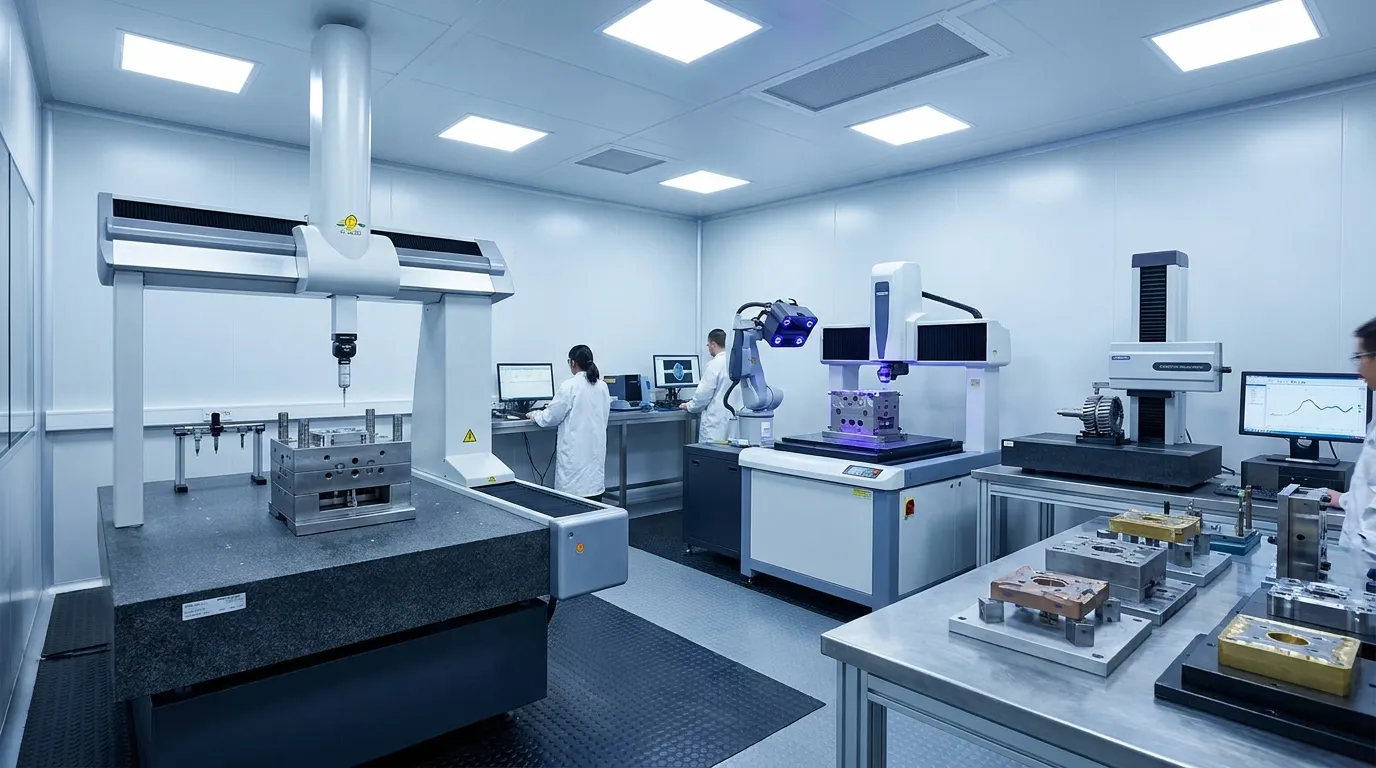
Manufacturers verify precision mold components using contour measurement systems, optical inspection, and dimensional metrology tools to confirm tolerance accuracy and surface conformity before production use.
Inspection matters because even small dimensional variation can affect mold performance. Most suppliers use multiple verification methods depending on component complexity and tolerance requirements.
According to MinebeaMitsumi, precision manufacturing depends heavily on dimensional consistency and stable machining accuracy.
Typical inspection process
- Initial dimensional measurement using calipers or micrometers
- Precision verification with CMM or contour measurement systems
- Surface inspection for wear marks or finishing defects
- Final repeatability validation before shipment
Optical inspection systems are common for smaller components with complex geometry. Contour measuring equipment helps verify profiles and edge accuracy on inserts and precision-fit parts.
Inspection also helps identify process drift before it becomes a production issue. In thin-wall molding, a ±0.01 mm alignment variation can create inconsistent cavity fill and visible defects across thousands of parts.
Are custom precision components always better than standard parts?
Custom precision components are not always the best choice. They work well for demanding molds with tight tolerances or unusual geometry, but standard components are often easier to replace and maintain during regular production.
The decision depends on production volume, complexity, and maintenance strategy. A custom component may improve cycle stability in a high-volume automotive mold, but it can also increase lead time and replacement cost.
Precision vs Standard Component Decision Table
| Situation | Better Choice | Why |
|---|---|---|
| High-volume production | Custom precision parts | Better long-term stability |
| Simple consumer products | Standard parts | Faster replacement |
| Tight tolerance molding | Custom parts | Improved alignment |
| Frequent maintenance environments | Standard parts | Easier sourcing |
| Complex mold geometry | Custom parts | Better fit and performance |
A buyer producing low-volume consumer products may gain little value from expensive custom alignment systems. On the other hand, medical or electronics molds often justify higher precision because downtime and defect rates carry much higher production costs.
The smarter approach is matching component strategy to production conditions instead of assuming tighter tolerance always improves results.
How do sourcing and customs delays affect precision component supply?
Precision mold components often have longer sourcing timelines because they require specialized machining, inspection, and export documentation. Customs delays can add another layer of risk when replacement parts are needed quickly.
Shipment documentation matters more in 2026 because import systems are stricter in several regions. The EU’s Import Control System 2 (ICS2) requires more detailed shipment information for imported goods.
A common problem is vague shipment labeling. One supplier described mold components simply as “machine parts,” which delayed customs clearance because the classification lacked enough detail.
Precision Component Shipping Checklist
- Confirm HS code accuracy before shipment
- Use detailed part descriptions
- Verify material documentation
- Include dimensional specifications when required
- Confirm destination compliance requirements
- Review import paperwork before dispatch
According to DHL guidance on customs delays and recent CBP trade bulletins, incomplete documentation remains a major cause of shipping disruption.
What to Do Next
Choosing the right precision components comes down to production stability, wear resistance, and realistic tolerance requirements. The best option is not always the tightest or most expensive part. It is the component that maintains accuracy over time without creating unnecessary maintenance cost or sourcing delays.
If you are reviewing mold performance problems, start with alignment systems, ejector components, and wear surfaces first. Those areas usually reveal the earliest signs of dimensional drift. For a broader understanding of mold systems and applications, this plastic injection mold guide provides additional context on how molds are designed and used across production environments.
Frequently Asked Questions
What are precision components used for in molds?
Precision components maintain alignment, dimensional accuracy, and repeatability inside mold systems. They help reduce defects, improve consistency, and extend mold lifespan during repeated production cycles.
What tolerance is considered high precision in mold manufacturing?
High precision in mold manufacturing commonly means tolerances around ±0.01 mm or tighter depending on the application. Critical mold areas may require even smaller variation for stable production.
Which mold components wear out the fastest?
Ejector pins, guide systems, and high-friction contact surfaces usually experience the fastest wear. Poor lubrication, misalignment, and abrasive materials accelerate failure.
Are coated mold components worth the cost?
Coated components often last longer and reduce friction in high-cycle production environments. The added cost is usually justified when downtime or replacement frequency becomes expensive.
How are precision mold parts inspected?
Manufacturers use contour measuring systems, optical inspection equipment, and dimensional metrology tools to verify tolerances and surface quality. Inspection confirms repeatability before production use.
Can standard mold components replace custom precision parts?
Standard components work well for many general applications, but custom parts are often necessary for tight tolerances, unusual geometries, or high-volume production stability.
Share:



Written By Sunshine
At Sunshine, we are a professional manufacturer and supplier of precision mould components, offering a wide range of products for stamping and injection mould applications. Our core focus includes punching dies, ejector pins and sleeves, and guide posts and bushings. With advanced CNC machining, strict quality control, and strong production capabilities, we ensure reliable, high-precision parts, along with in-stock standard components for fast and efficient global supply.
NEWS
GET SERVICE
With quality parts to meet every budget and friendly staff trained to make your visit informative and hassle free.
